

INTRODUCTION
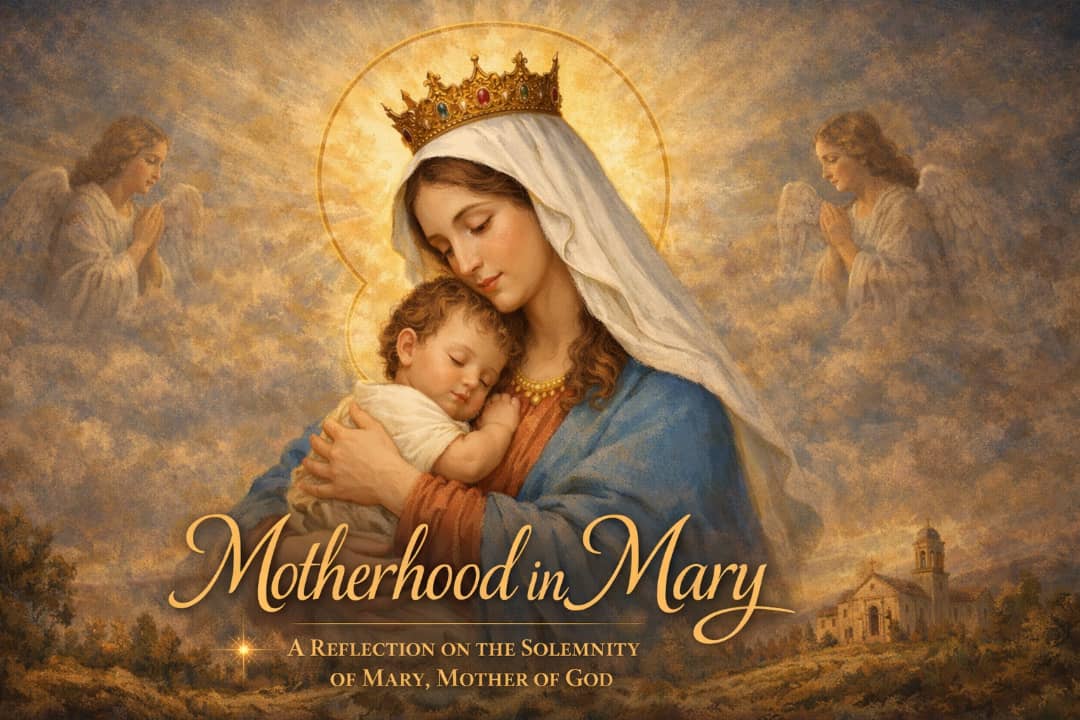
Beloved in Christ, today the Church invites the whole world to pause before a mystery so simple that even a child can know it, and yet so profound that the angels themselves never exhaust its wonder: God has a Mother. Not an idea, not a symbol, not a metaphor, but a real Mother. And in her motherhood, God teaches us who He is and how He loves.
Science, in its own limited language, tells us that three realities make “natural motherhood” possible: a womb, an ovum, and birth. When these realities pass through the life of Mary, they are lifted beyond biology and become theology. They become revelation.
THE WOMB
The womb is the hidden sanctuary where life is received, guarded, and allowed to grow in silence. Mary’s womb proclaims a demanding truth about God: He desires the whole heart, not a corner of it. Her womb was not shared. It was not divided. It was reserved entirely for Christ; no one before Him and no one after Him. Like the sealed tomb from which He would rise in glory, her womb was a dwelling prepared for God alone. And here lies the challenge for us: our hearts were never meant to be overcrowded spaces. They were created to be tabernacles, not marketplaces. God does not compete for space; He asks for surrender.
Furthermore, Mary’s womb also reveals something astonishing about God’s power and tenderness. Christ entered her womb without breaking her virginity, just as He entered the locked Room in which the Apostles were without breaking the doors (John 20:19 ). Barriers mean nothing to Him. If virginity did not stop God, then neither can shame. If sealed doors did not stop Him, then neither can poverty, weakness, sickness, or even sin. God is never intimidated by our limits. He does not ask permission from our brokenness before He comes. He enters because He loves.
OVUM
From the mystery of the womb, we are led into the mystery of the ovum. Just as God created trees without planting seeds, He also brought life to Mary’s womb without a male seed. (Gen 1:11) In this, He reveals Himself as the same God who does the impossible, the God we can always trust.
BIRTH
Scripture is largely silent about Mary’s physical condition at the moment of Jesus’ birth. The Gospels do not describe her labor pains, her exhaustion, or the bodily realities of childbirth. Yet the place of the birth itself speaks with remarkable theological force. Motherhood is concretely realized at the moment a child is born, and Mary’s motherhood began not in a prepared birthing chamber, but in a humble domestic space within a village home, a space that accommodated animals and contained a manger nearby. This reading, grounded in Catholic biblical scholarship and attentive to the lived realities of first-century Palestine, is supported by scholars such as Raymond E. Brown, Jerome Murphy-O’Connor, and John P. Meier, who emphasize that Luke envisions not a detached stable but an ordinary peasant home marked by poverty and humility.
Modern imagination often pictures Christmas as a serene scene with a clean crib and quiet reverence. Historical evidence, however, points to something more ordinary and far less ideal. In first century, Judea, many peasant homes consisted of a single main living area, with a lower section or adjacent space where animals were kept at night, especially during colder seasons. Luke is careful in his wording. He does not say that Jesus was born in a manger, but that He was laid in a manger. This distinction is significant. The manger mentioned by Luke was most likely a stone feeding trough built into the living space or lower area of the house, not a detached barn or stable. The birth itself would have taken place very near this feeding trough, in the same domestic setting where animals were present.
Such a space was not ritually or hygienically pristine by modern standards. Animals meant straw, dirt, odors, and the ordinary mess of rural life. Luke does not describe the environment as filthy, but neither does he suggest it was sanitized or specially prepared. The theological point is not squalor for its own sake, but ordinariness, poverty, humility, and lack of privilege. It was in this unembellished setting, close to the manger and among animals, that Mary gave birth. It was here that Jesus was laid in a manger. This is where Mary became Mother.
At this moment, the Gospel decisively shatters our illusions about God. God does not wait for ideal conditions. He does not insist on perfection before drawing near. He enters human life as it truly is, unadorned, vulnerable, and exposed. The incarnation does not occur after humanity has made itself worthy. It happens precisely because humanity cannot. God does not recoil from the mess of human existence. He steps into it.
The birth of Christ reveals a God who is unafraid of weakness, poverty, or limitation. Our sins do not shock Him. Our brokenness does not repel Him. Our instability does not delay Him. He enters the places we would rather hide, the mangers of our lives, our confused hearts, our wounded histories, our fragile faith, and He does not merely tolerate them. He transforms them. For this is why He came, not to wait until the world was clean, but to make it new from within.
Be that as it may, the humble space within which Jesus was born teaches one more thing: God changes whoever encounters Him. The shepherds, men marginalized and disregarded, walk into this space, and they walk out as witnesses and proclaimers of divine glory. It is like dough entering a heated oven: it goes in one way and comes out completely transformed, with a new name, bread, and a new appearance, brown. So too, an encounter with Christ changes us from the inside out.
CONCLUSION
Mary’s motherhood answers an ancient prayer whispered for centuries: “May the Lord let His face shine upon you.” For a long time, God was heard—through thunder, law, and prophecy. Now He is seen. Revelation has moved from a voice to a face. What once thundered from the mountain now smiles from a mother’s arms. It is like hearing a voice on the radio and then suddenly seeing the speaker step into the room, and you wonder, was it really you who was speaking all along? So, rejoice, beloved in Christ. God has a face. And through Mary’s motherhood, that face now shines upon us.
Author
SILAS KWADWO BOAHEN SARKODIE
References
Raymond E. Brown, The Birth of the Messiah: A Commentary on the Infancy Narratives in Matthew and Luke, updated ed. (New Haven, CT: Yale University Press, 1993), 394–399.
Joseph A. Fitzmyer, The Gospel According to Luke I–IX, Anchor Bible 28 (New York: Doubleday, 1981), 408–409.
James D. G. Dunn, Jesus Remembered, vol. 1 of Christianity in the Making (Grand Rapids, MI: Eerdmans, 2003), 344.
John P. Meier, A Marginal Jew: Rethinking the Historical Jesus, vol. 1 (New Haven, CT: Yale University Press, 1991), 210–214.


Leave a Reply