

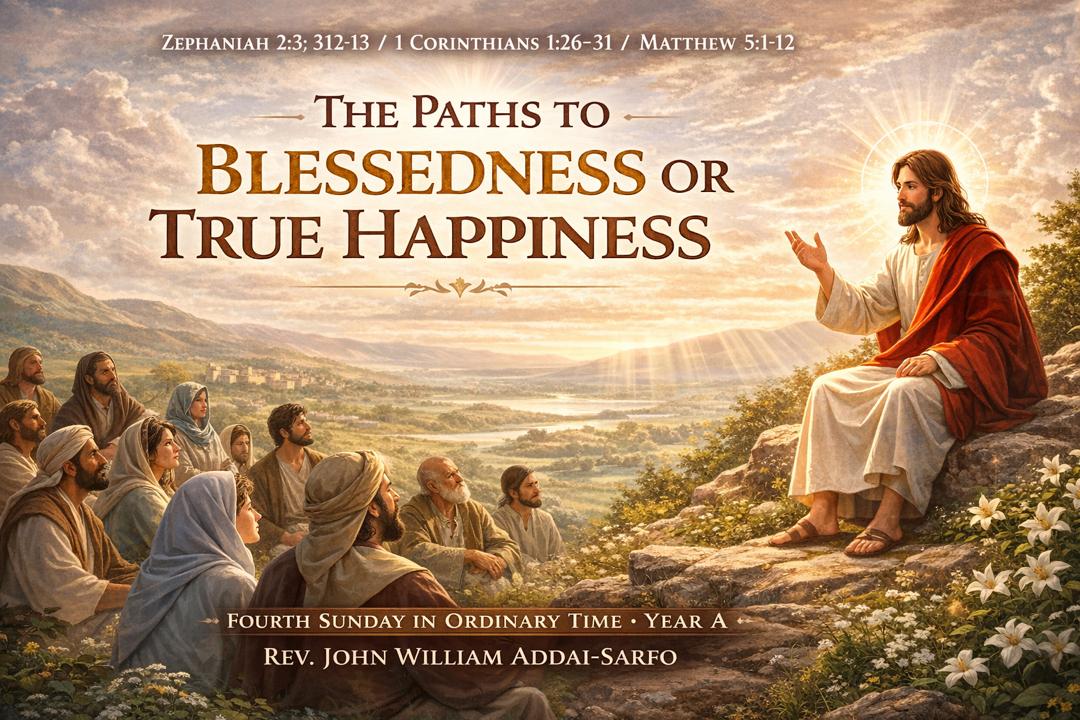
THE PATHS TO BLESSEDNESS OR TRUE HAPPINESS.
By Rev. John William Addai Sarfo
Today we celebrate the Fourth Sunday in Ordinary Time, Year A and we thank God for ushering us into a new month. My dear people of God, if we were to ask ourselves a simple but uncomfortable question – Why am I a Christian? Many answers might come to mind. Some may say, “Because God called me.” Others may say, “Because I desire to serve the God.” Yet beneath all these answers lies a deeper question: What kind of happiness am I truly seeking after achieving my aim in life? The world tells us that happiness is found in success, recognition, power, material things, and comfort. Even in the world, we can quietly absorb this thinking – measuring ourselves by academic excellence, ministerial visibility, material things, positions, wealth or spiritual reputation. But today’s first reading and the gospel challenge us to reconsider everything we think we know about happiness and the paths to true happiness which form the theme for today’s reflection.
Both Jesus and Zephaniah call their listeners away from arrogance and the desire for power, and instead invite them to seek justice, humility, and righteousness. In the Gospel, Jesus goes up the mountain, sits down, and begins to teach His disciples the Beatitudes. The Beatitudes are not simply reading a list of blessings; rather, we are being given the secret of true happiness. In fact, there are thirty-seven beatitudes in the New Testament, seventeen of which are sayings of Jesus Himself. This explains why the Catechism of the Catholic Church (CCC 1716) teaches that the Beatitudes are “at the heart of Jesus’ teaching.” The Beatitudes speak of a joy that persists even in pain, a joy that sorrow, loss, and suffering cannot destroy. As Jesus Himself says, “No one will take your joy from you” (John 16:22).
On the mountain, Jesus sits down and teaches – not about how to be successful, admired, or powerful – but about the paths that lead to happiness or blessedness. My dear people of God, I would like us to reflect on four of these ways that lead to true happiness or blessedness.
The first way is to be poor in spirit. The use of the word “Poor” in Greek, describes someone who is completely destitute. In Hebrew thought, however, “the poor” refers to the humble and helpless person who places total trust in God. Putting these together, Jesus is saying: Blessed is the person who recognizes his or her complete dependence on God and entrusts everything to Him. When a person realizes this dependence, he becomes detached from material things, knowing that they cannot provide lasting happiness or security and also becomes deeply attached to God, knowing that God alone gives true help, hope, and strength. The one who is poor in spirit understands that things mean nothing, but God means everything. Yet, many a times as clerics and seminarians, we are tempted to rely on our intelligence, power, connections like I know father X or father Y, or possessions forgetting that these friendships, power, intelligence can fail us. Jesus teaches us that the path to true happiness begins with humility and total reliance on God and not on man or on material things.
The second way is to be a peace maker and not just a peace lover. Jesus makes an emphatic statement that ‘Blessed are the peace makers’ and not peace lovers. True happiness does not come merely from loving peace, but from making peace. The happiness Jesus promises is found in the courage to face issues honestly, to address them with charity, and to restore broken relationships. As Christians and more so as people under formation, misunderstandings and tensions are inevitable among us. These misunderstandings sometimes are found between friends, family, in community, or within a society. A peace lover may choose silence or pretend that nothing is wrong, hoping the problem will disappear. A peace maker prayerfully seeks respectful conversation, listens with humility speaks the truth with charity, and works towards reconciliation. Jesus tells us to choose the path of peace making because it brings interior freedom and communal harmony therefore leading to lasting happiness which Jesus offers us today.
The third way is to be pure in heart. The word “Pure” in Greek originally meant ‘clean’. Its deeper meaning is unmixed, unadulterated, and sincere. Thus, this Beatitude may be translated as: Blessed is the person whose motives are pure and undivided, for such a person shall see God. This Beatitude calls us to deep self-examination. Why do we do what we do? Are our activities such as work, games, leadership in this world motivated by service or by self-interest? Is our ministry for Christ or for personal recognition? Do we come to church to encounter God or merely out of habit or because we are forced to come? Even in prayer, like coming early for adoration every morning, coming for recollections, or having spiritual exercises every Friday afternoon done to seek God or our motive is to be seen and applauded by the world? Purity of heart demands sincerity and pure motive in all we do. Only such hearts are capable of truly seeing God and leading us to happiness.
The fourth way is to be meek. The word ‘Meek’ is often misunderstood. Meekness does not mean weakness; rather, it describes someone who responds to injury with patience and conquers evil with good. The meek person does not retaliate when insulted, persecuted, or slandered. Jesus reveals a deeper truth: it is not violence but gentleness, not domination but love that ultimately prevails. As clerics and seminarians, we are to listen patiently in discussions rather than insisting in being right always, to respond to criticism with humility rather than hostility, and to accept misunderstanding without bitterness.
May the Lord grant us the grace to walk these paths of blessedness so that, we boast of the Lord as St. Paul in the second reading makes us aware in order that our hearts may find rest in God. Amen.


Leave a Reply