

Introduction
The Mass or the Eucharistic celebration properly consists of Liturgy of the Word and Liturgy of the Eucharist; distinct yet inseparable (Sacrosanctum Concilium, 56; CCC 1346; GIRM 28; Ecclesia de Eucharistia, no. 55; Sacramentum Caritatis, 44; CIC Canon, 897). For this reason, it is unthinkable to presume that Mass has been celebrated when a non-ordained priest (lay person, no matter how exulted or glorified) is deliberately assigned to conduct what is often called the Liturgy of the Word, merely for a validly ordained priest to continue with a so-called Liturgy of the Eucharist. At best, such an arrangement can be described as a Liturgy of the Word followed by the distribution of Holy Communion outside Mass. Even this description is imperfect, since consecration does not occur within a rite of Holy Communion outside mass, in which even an instituted acolyte serves only as an ordinary minister of Communion.
Number 55 of Redemptionis Sacramentum (RS) clearly distinguishes between the liturgies of Holy Communion outside of Mass and the Eucharist. It insists that the former may be carried out by lay members of the Church who provide the valuable ministry of distributing Holy Communion in the absence of an ordained priest. Indeed, “this function is to be understood strictly according to the name by which it is known, that is to say, that of extraordinary minister of Holy Communion, and not ‘special minister of Holy Communion’ nor ‘extraordinary minister of the Eucharist’ nor ‘special minister of the Eucharist’, by which names the meaning of this function is unnecessarily and improperly broadened” (RS, 156).
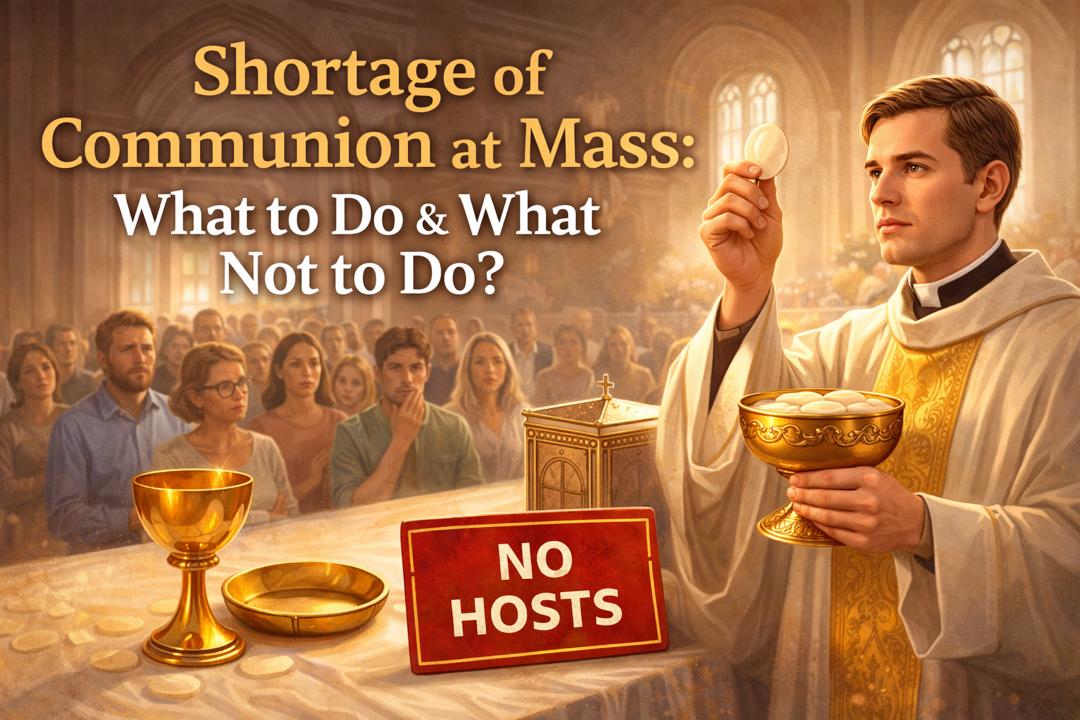
Turning now to the substance of this discussion: one of the perennial challenges faced by sacristans and masters of liturgical ceremonies is not only the proper planning of major liturgical celebrations, but also the prudent anticipation of the number of communicants at Eucharistic gatherings of (arch)diocesan, national, or international character. As I noted in my recent article, Receiving the Eucharist from the Sacrifice We Celebrate, contextualized by proportion, ‘it is safer to consecrate extra than to run out.’
If a shortage of consecrated hosts becomes apparent during the Eucharistic Prayer—whether before or during the consecration—it is not in itself wrong for a priest to consecrate additional hosts. However, since the Eucharist is not a series of independent consecrations but a single sacrificial action made present through one Eucharistic Prayer, it is illicit to attempt a second consecration by repeating the words of institution or by performing a separate consecration within the same Mass.
Beginning with the rites preceding the Liturgy of the Word (Entrance, Greeting, Act of Penitence, Kyrie, Gloria, and collect: GIRM 46-47; cf. Ceremonial of Bishops, 128), the Mass organically ascends to ‘the center and high point of the entire celebration’ (GIRM, 78; CCC 1352), namely the Eucharistic Prayer, and then effectively descends toward the dismissal (GIRM 90), bearing a missionary effect. As a unified whole, ‘the Mass consists in some sense of two parts, namely the Liturgy of the Word and the Liturgy of the Eucharist, these being so closely interconnected that they form but one single act of worship’ (GIRM 28).
To repeat the consecration within the same Mass obscures and fragments this sign of unity. Hence, the Congregation for Divine Worship and the Discipline of the Sacraments cautions: ‘it is not licit to separate one of these parts from the other and celebrate them at different times or places. Nor is it licit to carry out the individual parts of Holy Mass at different times of the same day’ (RS, 60). Consequently, an ordained priest cannot consecrate bread or wine without first celebrating the Liturgy of the Word, through which the Word is proclaimed and assumed as flesh. To do otherwise is to consecrate the sacred species outside the Eucharistic celebration, or, as it is often described, to celebrate another Mass within the Mass itself (cf. CIC Canon 927).
To be continue…




Leave a Reply