

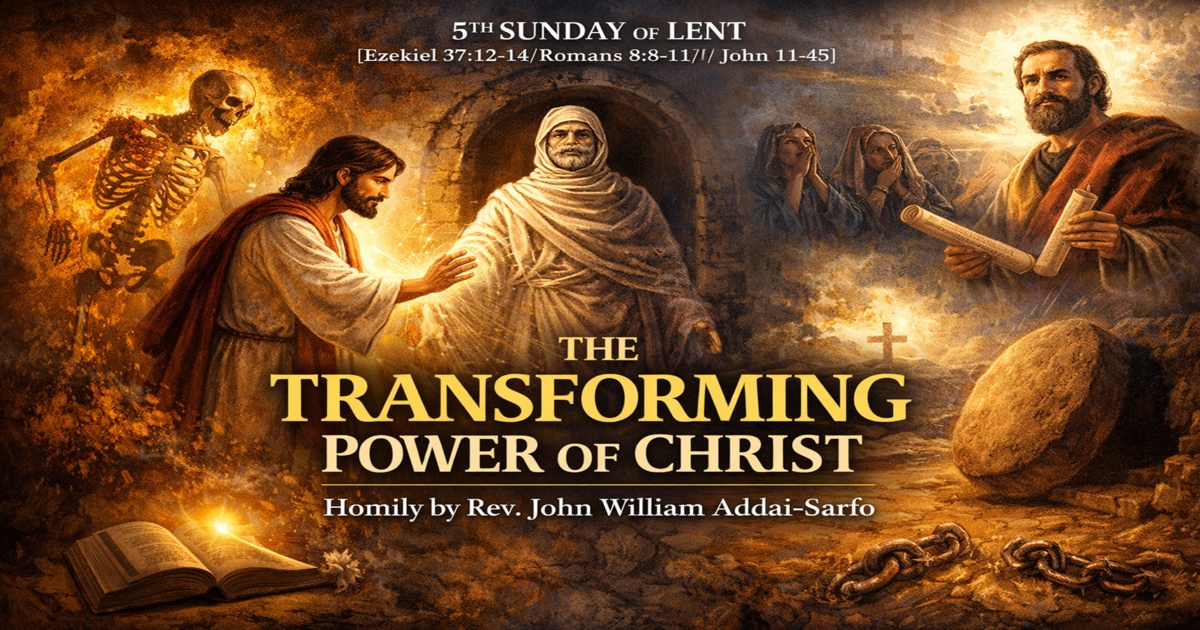
THEME: THE TRANSFORMING POWER OF CHRIST.
By Rev. John William Addai-Sarfo
My dear people of God, the fifth Sunday of lent in year A leads us into one of the most profound and emotionally powerful moments in the Lenten journey: the raising of Lazarus in Gospel of John, together with the promise of restoration in the Book of Ezekiel and St. Paul’s teaching on life in the Spirit in Romans. All three readings proclaim one central truth: God through his transformative power brings His people from death to life. As we approach the Holy Week, the liturgy invites us to encounter Christ who alone has the power to transform our lives. I would like us to look at four important points that will help us experience the transforming power of Christ.
The first is to acknowledge the tombs in our lives. Lazarus has been dead for four days. There is no illusion. Martha even warns Jesus: “Lord, by now there will be a stench.” Death is real. It is uncomfortable. It is final. But the Gospel invites us to ask: Where are the tombs in our own lives?
Some Christians today carry silent burdens like, a marriage that feels cold, a prayer life that has dried up, a hidden sin that keeps returning, and a wound from the past that refuses to heal. The prophet Ezekiel speaks to a people who felt like dry bones-scattered, hopeless, lifeless. Many believers today feel the same interior exile. We attend Mass, we say our prayers, yet something within feels buried.
Before resurrection comes honesty. Lent invites us to admit: “Lord, this area of my life is dead.” And yet the Gospel shows us something beautiful: Jesus does not avoid the tomb. He approaches it. He even weeps. Our God is not distant from our pains, our area of struggles and sufferings. Jesus is ready to approach and transform us if we admit the tombs in our lives.
The second is to trust God even when He seems late. One of the most emotional parts of today’s Gospel is that Jesus delays. If He had come earlier, Lazarus would not have died. Martha says ‘‘Lord, if you had been here…’’ Many Christians today whisper those same words like ‘‘Lord, if you had intervened earlier…’’, ‘‘Lord, if you had healed sooner…’’, ‘‘Lord, if you had answered that prayer…’’ The delay of Jesus is painful. But it is not abandonment. Jesus’ delay reveals something significant that is, Jesus acted entirely on his own initiative and not on the persuasion of anyone else.
He takes action, not because he is compelled to do so, but entirely on his own initiative. It is a warning to us. So often we would like Jesus to do things in our way; we must leave him to do them in his own way. Sometimes as Christians we tend to think that God does not listen to our prayers, he feels silent in our troubles and so, we begin to say God did not take action on our prayers. Jesus tells us today that he takes action when the time is due and so, when prayers seem unanswered, let us continue trusting, when the silence feels heavy, let us remain faithful, and when God seems late, let us remember He is never absent but working in our lives. He is always ready to transform our difficult marriages, struggles in work places, and our suffering state in life as he did for the family of Lazarus.
The third is to remove the stone and let grace enter. Before raising Lazarus, Jesus commands: ‘‘Take away the stone’’. He could have moved it Himself. But He asks for cooperation. The stone represents everything that seals us off from grace like pride, unforgiveness, comfort with habitual sin, fear of change, and spiritual complacency. John Paul II often spoke of human freedom as a gift that must cooperate with grace. God does not save us without us. He invites participation. Christ stands before our tombs and waits for our permission. Lent is the moment to roll away the stones of anger, pride, unforgiveness, backbiting, hatred and other vices in our lives and let grace enter. God will do whatnwe cannot do. But He asks us for our cooperation so that Jesus’ transforming power will be felt in our lives.
The fourth is to unbind from our lives bad attitudes. Jesus in the Gospel made a powerful statement: “Lazarus, come forth.” Jesus calls him by name. He still calls by name today. He calls the discouraged Christian. He calls the addicted. He calls the lukewarm believer. He calls the one who feels spiritually exhausted. Lazarus came forth but was still wrapped in burial cloths. Even after resurrection, there are bindings. So Jesus says, ‘‘Unbind him, and let him go.’’ Grace must lead to transformation. As weak as we are God has called us. Jesus makes us aware that this calling is not enough but to unbind from us our bad attitudes so as to feel Christ’s transforming power. Also, if we have received our prayer requests, if we have been saved from many dangers, death and sickness, then we are called to unbind from us our past lifestyles and walk in newness of life.
My dear people of God, Christ invites each of us to hear his call personally and as we approach Holy Week, may we acknowledge our tombs, trust God in delay, remove the stones of sin, and unbind our past bad attitudes. Amen.



Leave a Reply