


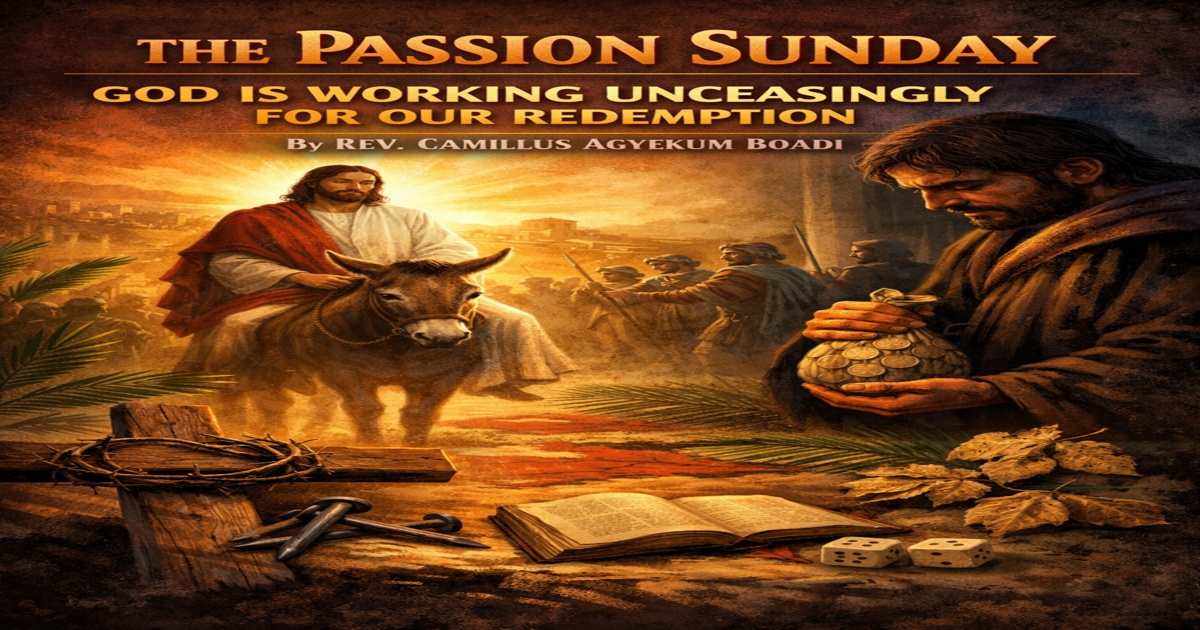
GOD IS WORKING UNCEASINGLY FOR OUR REDEMPTION
By REV. CAMILLUS AGYEKUM BOADI
Palm Sunday stands at the threshold or the entrance of the Passion narrative. It invites us to reflect deeply on the paradoxes of God’s victorious salvific work. I want us to focus on three things: that is; Jesus’ betrayal of Judas Iscariot, rooted in Judas’ betrayal of Jesus, the donkey and a horse, and fig leaves and palm leaves.
1. Jesus betrayed Judas: Judas’ Misguided Expectation:
The Bible explicitly states some reasons why Judas betrayed Jesus. He did that because; first, he is greedy, loves money, and is a thief (John 12:4-6); Second, he was influenced by Satan (Luke 22:3-4); third, as a fulfillment of prophecy.
Today, I would want us to assess a different probable obscured reason by looking at it from a different perspective; that is, Jesus’ betrayal of Judas Iscariot. Peter, James and John, and the people who were singing Hosanna, misconstrued Jesus’ messianic role as a political leader who will liberate them from the Roman’s oppression. Judas, walking with Jesus also misconstrued his salvific role. He had seen him work a lot of miracles, such as; healing, deliverance and others. There are moments the chief priests wanted to stone Jesus or arrest him but they could not. Judas witnessed all these. Judas misunderstood Jesus’ power and mission. For Judas, Jesus is that powerful master, whom the people cannot arrest. They could not arrest him in John 8:58, when he said ‘before Abraham was, I am.’ Therefore, for Judas, if he sells Jesus out, he will get money and the people cannot arrest Jesus because he is powerful and he believes in Jesus’ power. May be, that is why, Judas, having been caught by Jesus, as regards his plans, he still went ahead to sell him. He never thought Jesus will surrender to his captors. At the arrest of Jesus, he betrayed Judas. He did not use his powers. Judas regretted for haven betrayed an innocent blood.
Dear brothers and sisters in Christ, we misunderstand Jesus every day when we have weird expectations as to how he should act. God does not act according to human manipulations or expectations. Judas’ failure lies not just in betrayal, but in imposing his own expectations on God’s plan. When we go into tribulations, we have a lot of expectations. But God works in diverse ways towards our salvation.
There is a story told of a traveler who upon looking back and seeing four footsteps recognized that God was present with him. Later, he started seeing two in moments of difficulties and he thought God was not with him. Later, he recognized that those two were actually that of God who hascarried him on his arms in those difficulties. God is working unceasingly to save humanity in ways we do not understand. (Sifted and redeveloped from Mary Stevenson’s Poem, Footprints in the Sand)
2. Human Expectations vs. God’s Ways
This tension is captured powerfully in Isaiah 55:8 – 9, “For my thoughts are not your thoughts, neither are your ways my ways.” Palm Sunday embodies this truth. The crowd expects a political savior; God sends a suffering servant. Judas expects a display of power; Jesus chooses surrender. Humanity seeks immediate solutions; God works through a redemptive process. We often approach God like the crowd, waving our “palm leaves,” praising Him when He seems to meet our expectations, yet struggling when His ways differ from ours. Palm Sunday invites us into a deeper understanding of God’s work. What are God’s works?
God’s Works
In Genesis 3:7, Adam and Eve sewed fig leaves together to cover their shame. It symbolized human effort to deal with sin and brokenness by our own means. It withered away and they became naked again. Yet, in Genesis 3:21, God replaces these fragile coverings with garments of skin. To collect the skin of an animal, you have to kill it. God therefore made the first sacrifice towards our salvation. God is always working tirelessly for our redemption right from the beginning of creation. But his ways are different.
Dearly beloved in Christ, we expect Jesus, as a king to have sat on a horse instead of a donkey, but we discover that God’s power is revealed in humility. His ways are different. He sometimes opens a new door to our salvation but because we are bent on a particular door, we are blinded by our own expectations; how God should use his power to save us. Our plans are not God’s purpose. Our watch cannot tell God what his time is. God loves us and he is with us.
Palm Sunday calls us not just to celebrate Jesus, but to understand Him; to move from shallow expectation to genuine faith, trusting that even when God’s ways seem hidden or difficult, they are always higher, wiser, rooted in love. Jesus loves us and he is going to die for us.



Leave a Reply