

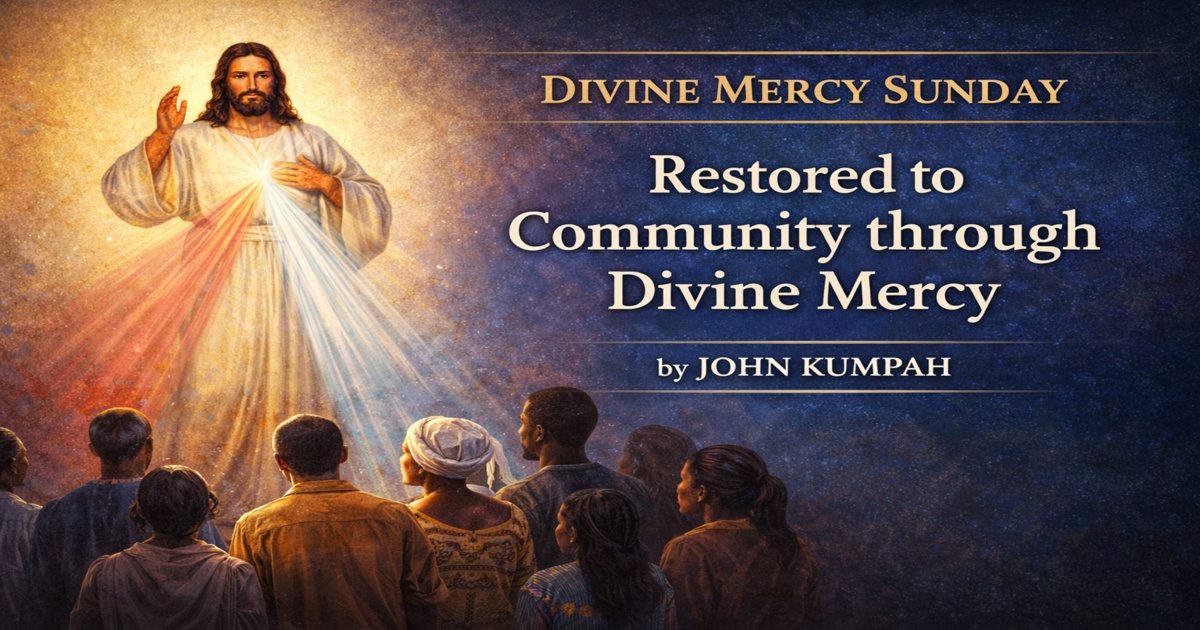
Restored to Community through Divine Mercy
By Rev. John Kumpah
My dear brothers and sisters in Christ, in our traditional African society, especially among the Akan people, when a member of the community commits a serious offense, the aim of justice is not merely punishment but restoration. When someone wrongs the community through disrespect, betrayal, or wrongdoing, elders gather, dialogue takes place, confession is encouraged, and reconciliation is sought. After the necessary steps, the offender is welcomed back into the community because African wisdom teaches that a person must not be permanently discarded.
This African philosophical vision mirrors the mystery we celebrate today on Divine Mercy Sunday. Humanity sinned against God, failed in fidelity, and hid in fear like Adam in the garden. Yet God did not abandon humanity. Instead, through the death and resurrection of Jesus Christ, God chose restoration over rejection. Divine Mercy Sunday reveals that God acts like the wise elder who restores broken relationships and reintegrates His children into communion. In the light of these, I will like to reflect with you on the readings given the theme ‘Restored to Community through Divine Mercy’
The feast of Divine Mercy Sunday is celebrated on the Sunday after Easter. Its origin is connected to the spiritual experiences of Saint Faustina Kowalska in the early twentieth century, through whom Jesus emphasized the urgency of trusting in His mercy and extending mercy to others. The Church established this feast to help Christians understand the deepest meaning of Easter: The Resurrection is the victory of divine mercy over sin, fear, and death. The purpose of this celebration is to strengthen our trust in God’s compassion, to encourage reconciliation through forgiveness of sins, and to form believers into instruments of mercy within the world.
The Gospel of today presents a powerful image. The disciples are gathered behind locked doors out of fear (John 20:19). These are the same disciples who walked with Jesus, yet they abandoned Him during His Passion. Fear, shame, and disappointment imprison them. The locked doors symbolize not only physical protection but also spiritual closure, their hearts burdened by guilt and uncertainty.
This situation speaks strongly to us. Many people live behind invisible locked doors: fear of failure, shame from past mistakes, unresolved family conflicts, or anxiety about the future. Some carry guilt silently; others feel spiritually distant from God. Yet the Gospel tells us that the risen Jesus enters even when doors are locked. Mercy is not stopped by human weakness.
The first words of Jesus are remarkable: “Peace be with you” (John 20:19). He does not accuse them of betrayal. He does not remind Peter of denial or the others of abandonment. Instead, He offers peace. Divine mercy begins not with condemnation but with reconciliation. Jesus then shows them His wounds. The wounds remain, but they are transformed. They are no longer signs of defeat but sources of healing. In the same way, God does not erase our past; He redeems it and turns our wounds into testimonies of grace.
Jesus breathes on the disciples and says, “Receive the Holy Spirit” (John 20:22). This action recalls Genesis 2:7, when God breathed life into Adam. A new creation is beginning. Humanity is recreated through mercy. Immediately afterward, Jesus entrusts the Church with the ministry of forgiveness: “Whose sins you forgive are forgiven them” (John 20:23). Mercy therefore becomes concrete and sacramental. Through the Church, especially in the Sacrament of Reconciliation, believers encounter the healing mercy of God.
In many places, including our own communities, people sometimes avoid confession because of shame or fear. Divine Mercy Sunday reminds us that confession is not a place of humiliation but of restoration. Just as elders reconcile members within African communities, Christ restores sinners through the ministry of the Church.
The encounter with Thomas further deepens this message. Thomas doubts the resurrection and demands proof. Yet Jesus does not reject him. Instead, He invites Thomas to touch His wounds (John 20:27). Mercy shows patience toward human weakness. In African culture, elders often listen patiently before correcting a younger person; restoration requires understanding. Jesus meets Thomas where he is, and Thomas responds with one of the most profound confessions of faith in Scripture: “My Lord and my God!” (John 20:28). Doubt, when embraced by mercy, becomes deeper faith.
The first reading from Acts of the Apostles shows the practical result of divine mercy. The early Christians devoted themselves to teaching, fellowship, breaking of bread, and prayer (Acts 2:42). They shared their possessions so that no one was in need. Mercy created a new kind of community. This resembles the traditional African communal spirit where people support one another during funerals, harvests, and crises. Divine mercy is not merely spiritual emotion; it transforms social relationships and builds solidarity.
What then is God saying to us today? First, we are invited to trust in God’s mercy. No sin is greater than God’s love. Like the disciples, we must allow Christ to enter the locked rooms of our hearts. Second, we are called to forgive others. Families divided by resentment, friendships broken by misunderstanding, and communities wounded by conflict can only be healed through mercy. Third, we must practice mercy concretely: caring for the poor, supporting widows and orphans, helping those in distress, and acting with compassion in daily interactions. Mercy must be visible in how we live.
Finally, Divine Mercy Sunday reminds us to show mercy even to ourselves. Many people remain prisoners of past mistakes, believing they are unworthy of God’s love. Yet the risen Christ stands before us and repeats the same words: “Peace be with you.” God’s mercy is always greater than our failures.
As the Gospel concludes, Jesus says, “As the Father has sent me, so I send you” (John 20:21). Every Christian becomes a messenger of mercy. We are sent into our homes, workplaces, schools, and communities to become instruments of reconciliation and compassion.
Today, the risen Lord stands among us just as He stood among the disciples. He does not come with accusation but with peace. He does not come to condemn but to restore. Like the wise elders of African tradition who reintegrate a fallen member into the community, God restores us to communion through His mercy.
May our families become places of forgiveness, our Church a refuge of compassion, and our society a community shaped by mercy. And may we always pray with trust the words associated with the devotion entrusted through Saint Faustina Kowalska:
Jesus, I trust in You.


Leave a Reply