

By Rev. Fr. Samuel Atta Okyere
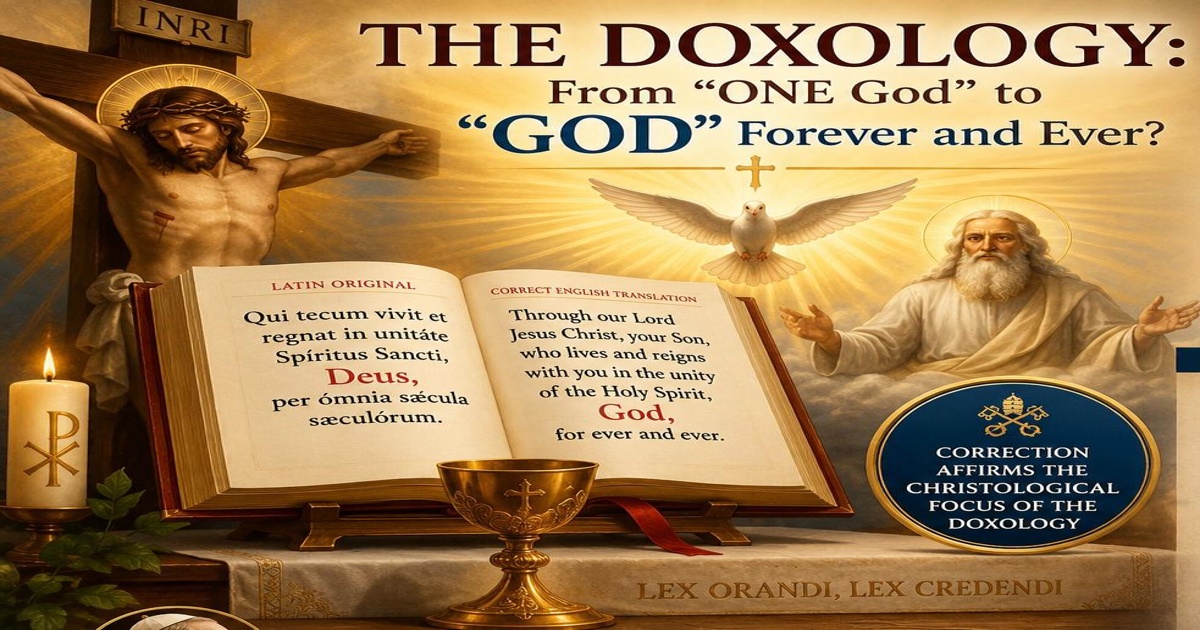
Taking effect on 17 February 2021, the Congregation for Divine Worship and the Discipline of the Sacraments, in May 2020, as it had for the episcopal conferences of England and Wales, Ireland and Canada, drew the attention of the English-Speaking Bishops’ Conferences, and by implication the Church in Ghana, to an incorrect translation of the doxology: “Qui tecum vivit et regnat in unitáte Spíritus Sancti, Deus, per ómnia sǽcula sæculórum.
In the Latin text, there is clearly no unus (“one”) qualifying Deus (“God”). In addition, Deus as used in this concluding formula refers to Christ and not directly to the Holy Trinity. In the Order of Mass, for example, following the Memorial Acclamation and the anamnesis of our redemption, the Church offers all glory and honour to God the Almighty Father through Christ, with Christ, and in Christ, in the unity of the Holy Spirit (cf. Ordo Missae, nos. 98, 106). The doxology is therefore directed to the Father through the Son in the unity of the Holy Spirit, rather than being addressed to the Holy Trinity as such.
Accordingly, the correct English translation is: “Through our Lord Jesus Christ, your Son, who lives and reigns with you in the unity of the Holy Spirit, God, for ever and ever,” rather than: “Through our Lord Jesus Christ, your Son, who lives and reigns with you in the unity of the Holy Spirit, one God, for ever and ever.” The conspicuous absence of unus (“one”) before Deus (“God”) in the Latin text indicates that the phrase “one God” as found in some translations introduces a nuance absent from the original and potentially obscures the Christological focus of the prayer.
Since language serves as a vehicle of faith formation and not merely as a tool of communication, this correction is both necessary and worthwhile—not only for the sake of fidelity to the original text, as encouraged by Varietates Legitimae (cf. nos. 53–55), but also because of its doctrinal significance. Thus, the doxology is strictly to the Father through the Son in unity of the Holy Spirit, and not to the Holy Trinity.
Contrary to the Christocentric character of the doxology affirmed by the Congregation for Divine Worship and the Discipline of the Sacraments, the insertion of “one God” can suggest a collective reference to the three Divine Persons. The correction therefore preserves the precise theological structure of the prayer, affirming the divinity of Christ within the unity of the Holy Spirit without conflating this specific Christological reference with a broader Trinitarian declaration.
As Pope Pius XII teaches: “On this depends in no small way the efficacy of our prayers. These prayers in fact, when they are not addressed directly to the Word made man, conclude with the phrase ‘though Jesus Christ our Lord.’ As our Mediator with God, He shows to the heavenly Father His glorified wounds, ‘always living to make intercessions for us’” (Mediator Dei, 146).
As the Prefect of the Congregation observed, although this departure from the original Latin text and its theological meaning had been perpetuated for a considerable period, the correction is important for “affirming this Christological truth amid the religious pluralism of today’s world.” Consequently, regardless of how minor the change may appear, it directly concerns the principle of lex orandi, lex credendi and therefore deserves careful attention.
Accordingly, the Congregation confirmed the amendments approved by the Bishops of the United States Conference of Catholic Bishops (USCCB) regarding the concluding doxologies of the Roman Missal. As found on their official webpage, the General Instruction of the Roman Missal (no. 54) states:
“Then the Priest pronounces the prayer usually called the ‘Collect’ and through which the character of the celebration finds expression. By an ancient tradition of the Church, the Collect prayer is usually addressed to God the Father, through Christ, in the Holy Spirit, and is concluded with a Trinitarian ending, or longer ending, in the following manner:
- If the prayer is directed to the Father: Per Dominum nostrum Iesum Christum Filium tuum, qui tecum vivit et regnat in unitate Spiritus Sancti, Deus, per omnia saecula saeculorum (Through our Lord Jesus Christ, your Son, who lives and reigns with you in the unity of the Holy Spirit, God, for ever and ever);
- If it is directed to the Father, but the Son is mentioned at the end: Qui tecum vivit et regnat in unitate Spiritus Sancti, Deus, per omnia saecula saeculorum (Who lives and reigns with you in the unity of the Holy Spirit, God, for ever and ever);
- If it is directed to the Son: Qui vivis et regnas cum Deo Patre in unitate Spiritus Sancti, Deus, per omnia saecula saeculorum (Who live and reign with God the Father in the unity of the Holy Spirit, God, for ever and ever).
The people, uniting themselves to this entreaty, make the prayer their own with the acclamation, Amen.”
Similarly in Ghana, the correction of such doxologies may need to be reflected in the various vernacular translations. This should be done in accordance with the principles of preserving the Christological reference of Deus (“God”) to Jesus Christ and avoiding the insertion of unus (“one”), which risks obscuring or altering the Christological nature of the doxology. For example, in Twi, the formula may be rendered as: “Ɔno a Ɔne wo ne Sumsum Kronkron no te ase di hene, Nyame, ‘ԑmmerԑ a ԑnni awieԑ’ (mfensa mu fensa),” rather than: “Ɔno a Ɔne wo ne Honhom Kronkron no te ase di hene, Nyame bafua, ‘ԑmmerԑ a ԑnni awieԑ’ (mfensa mu fensa).”
Likewise, in Ewe, rather than: “Míebia esia to viwo Aƒetɔ Yesu Kristo me amesi nye Mawu le agbe hele fia ɖum kple wò le Gbɔgbɔ Kɔkɔe la ƒe ɖekawɔwɔ me, Mawu ɖeka, tso mavɔ heyi mavɔ”, the translation may appropriately read: “Míebia esia to viwo Aƒetɔ Yesu Kristo me amesi nye Mawu le agbe hele fia ɖum kple wò le Gbɔgbɔ Kɔkɔe la ƒe ɖekawɔwɔ me, tso mavɔ heyi mavɔ.”
Ultimately, the correction of the translated original Latin text serves as a reminder that in the liturgy, words matter profoundly. They shape belief, guide prayer, and express the mystery of faith. By safeguarding the theological precision of liturgical language, the Church not only preserves doctrinal integrity but also enriches the spiritual lives of the faithful, enabling them to encounter the mystery of Christ more fully in the language of their hearts.


Leave a Reply