

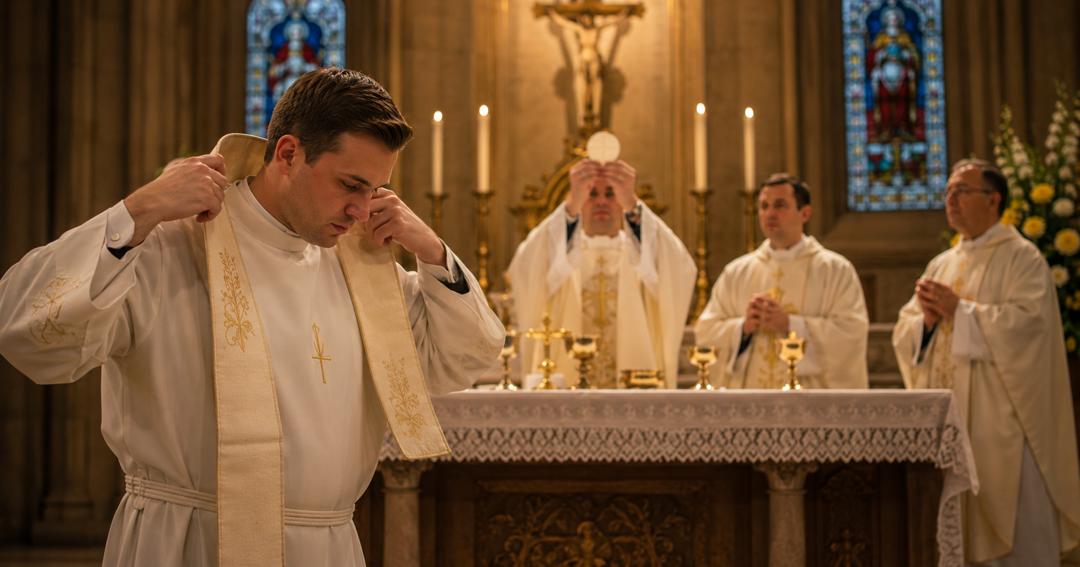
Since the Mass begins with the Introductory Rites preceding the Liturgy of the Word (cf. GIRM, 46; Pope Francis, General Audience, 20 December 2017), it is improper for a priest to concelebrate at a Mass that has already begun.
As explicitly stated by Inaestimabile Donum (8), “concelebration, which has been restored in the Western Liturgy, manifests in an exceptional manner the unity of the priesthood. Concelebrants must, therefore, pay careful attention to the signs that indicate that unity. For example, they are to be present from the beginning of the celebration, they are to wear the prescribed vestments, they are to occupy the place appropriate to their ministry as concelebrants, and they are to observe faithfully the other norms for the seemly performance of the rite.”
GIRM 206 further strengthens this position: “No one is ever to join a concelebration or to be admitted as a concelebrant once the Mass has already begun.” Accordingly, a priest who arrives late is not to join the concelebration of his own accord. If he nevertheless attempts to do so, he should be refused admission as a concelebrant.
Understandably, there are occasions such as ordinations, first masses of newly ordained priests, funerals, weddings, various anniversaries when priests may wish to express solidarity with the faithful and their brother priests yet arrive late for various reasons. In such situations, the temptation may arise either to assert a non-existent clerical privilege or to make an emotional appeal to fraternal concelebration and the constraints of time.
Yet, apart from the need to provide a good example, should not the priest’s intention to safeguard and foster at least, the material integrity of the Eucharistic celebration, together with his effort to preserve a prayerful and undisturbed atmosphere, constitute the overriding principle (cf. GIRM 42)?
To begin with, it must be acknowledged that concelebration in the instances mentioned above is recommended rather than prescribed (cf. GIRM 199; CIC, can. 904). Furthermore, the already cited GIRM 206 remains applicable, while adding that, when necessary, a seat may be provided for the late-arriving priest in a discreet location near the sanctuary. He may vest in a cassock and surplice, or in an alb, but not as a concelebrant, who ordinarily wears an alb, stole, and chasuble (cf. GIRM 209).
Now, a few questions arise:
- Probably inspired by Inaestimabile Donum (no. 1: “A person should not approach the table of the Bread of the Lord without having first been at the table of His Word”), do some priests not discourage the laity from presenting themselves for Holy Communion when they arrive late for Mass? What, then, of the ordained priest, who, together with the common priesthood of the faithful, makes Christ’s faithful people?
- It is worth recalling the observation of Pope Francis: “The Church is the holy faithful People of God of Lumen Gentium; it is neither populism nor elitism. And this cannot be learned theoretically; it is understood by living it” (18 February 2023).
- More paradoxically, in secular programmes, do not some proponents of the liturgical practice under discussion willingly decline a place at the high table, remain seated among the general audience, and accept only a simple acknowledgment so as not to distract from the event? If such restraint is possible in secular settings, why should it not be exercised during the Holy Mass?
As Henri de Lubac makes us understand, “the Eucharist builds the Church (of which priests are an integral part) and the Church makes the Eucharist” (Ecclesia de Eucharistia, 26). Consequently, all Christ’s faithful are bound to approach the Eucharistic Mystery with the highest devotion and adoration (cf. CIC, can. 898) and to safeguard its sanctity. For without the Eucharist there is neither Church nor ministerial priesthood. Priests, who are privileged sharers in Christ’s ministerial priesthood, therefore have a particular obligation to protect, honour, and foster the dignity of this sacred Mystery.
Here, “I think of the regular rhythm of our assemblies that come together to celebrate the Eucharist on the Lord’s Day, Sunday after Sunday, Easter after Easter, at particular moments in the life of each single person and of the communities, in all the different ages of life. Ordained ministers carry out a pastoral action of the first importance when they take the baptized faithful by the hand to lead them into the repeated experience of the Paschal Mystery. Let us always remember that it is the Church, the Body of Christ, that is the celebrating subject and not just the priest. The kind of knowledge that comes from study is just the first step to be able to enter into the mystery celebrated. Obviously, to be able to lead their brothers and sisters, the ministers who preside in the assembly must know the way, know it from having studied it on the map of their theological studies but also from having frequented the liturgy in actual practice of an experience of living faith, nourished by prayer — and certainly not just as an obligation to be fulfilled. On the day of his ordination every priest hears the bishop say to him: ‘Understand what you will do, imitate what you will celebrate, and conform your life to the mystery of the Lord’s Cross”’ (Desiderio Desideravi, 36).
In humility, therefore, if all ordained ministers acknowledge themselves to be graced stewards of the sacred mysteries rather than their masters (cf. Sacrosanctum Concilium, 19; GIRM 24), God will be glorified, the dignity of the liturgy will be preserved, and His Church will continue to grow in holiness and unity.





Leave a Reply