

By Rev. Fr. John William Addai-Sarfo
The Holy Eucharist occupies the central place in the life of the Church. As the Sacrament of the Body and Blood of Christ, it is the greatest treasure entrusted to the Church by her Lord. Because of its sacred character, the Church has established precise norms governing its celebration, distribution, and reception.
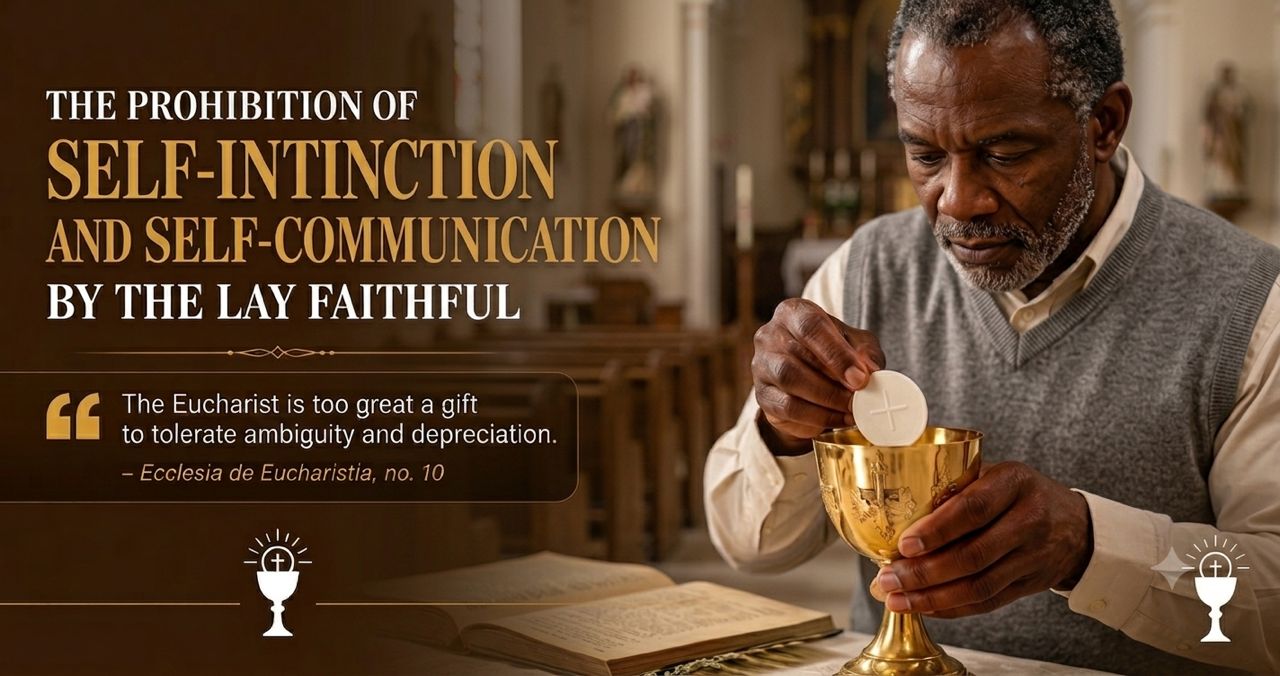
The Eucharist is fundamentally a gift from Christ to His Church. The very name “Communion” signifies a participation in the life of Christ received through the ministry of the Church. Pope Saint John Paul II emphasized this truth:“The Eucharist is too great a gift to tolerate ambiguity and depreciation.” (Ecclesia de Eucharistia, no. 10). The faithful therefore approach Holy Communion not as owners of the sacred mysteries but as recipients of God’s gift. The manner of reception reflects this reality.
The Instruction Redemptionis Sacramentum no. 94 states: “The faithful should normally receive sacramental Communion from the Priest celebrant or from extraordinary minister of Holy Communion. They should not be permitted to take up the consecrated Bread or the sacred Chalice by themselves, and still less to hand them on from one to another.” Communicants must not be permitted to intinct the host themselves in the chalice, nor to receive the intincted host in the hand. (Redemptionis Sacramentum, no. 104). These norms prohibit the practice of communicants helping themselves to the Sacred Host or the Chalice.
The practice of self-communication and self-intinction belong properly to the principal celebrant and concelebrating priests because, in celebrating the Eucharistic Sacrifice, they exercise their priestly ministry in persona Christi capitis (in the person of Christ the Head) (GIRM 158,242, CCC 1548). By contrast, priests who are present but do not concelebrate, deacons, and extraordinary ministers of Holy Communion do not celebrate the Eucharistic Sacrifice in persona Christi capitis and therefore do not self-communicate or self-intinct. Instead, they receive Holy Communion from the celebrant or extraordinary minister of Holy Communion according to the norms of the Church.
GIRM no. 287 further explains the proper procedure: “The Priest takes a Host, intincts it partly in the Chalice and, showing it, says: ‘The Body and Blood of Christ.’ The communicant replies: ‘Amen,’ receives the Sacrament in the mouth from the Priest, and then withdraws.”. The minister performs the intinction; the communicant receives the Eucharist.
To end it all, among these norms are two important disciplines to be adhered to: first, that communicants do not dip the Sacred Host into the Precious Blood themselves (self-intinction), and second, that they do not take Holy Communion for themselves as though helping themselves to ordinary food. Rather, Holy Communion is to be received from the ordained minister or an extraordinary minister of Holy Communion (GIRM 160).



Leave a Reply