

By Rev. Fr. Bismark Safie Darko
Introduction
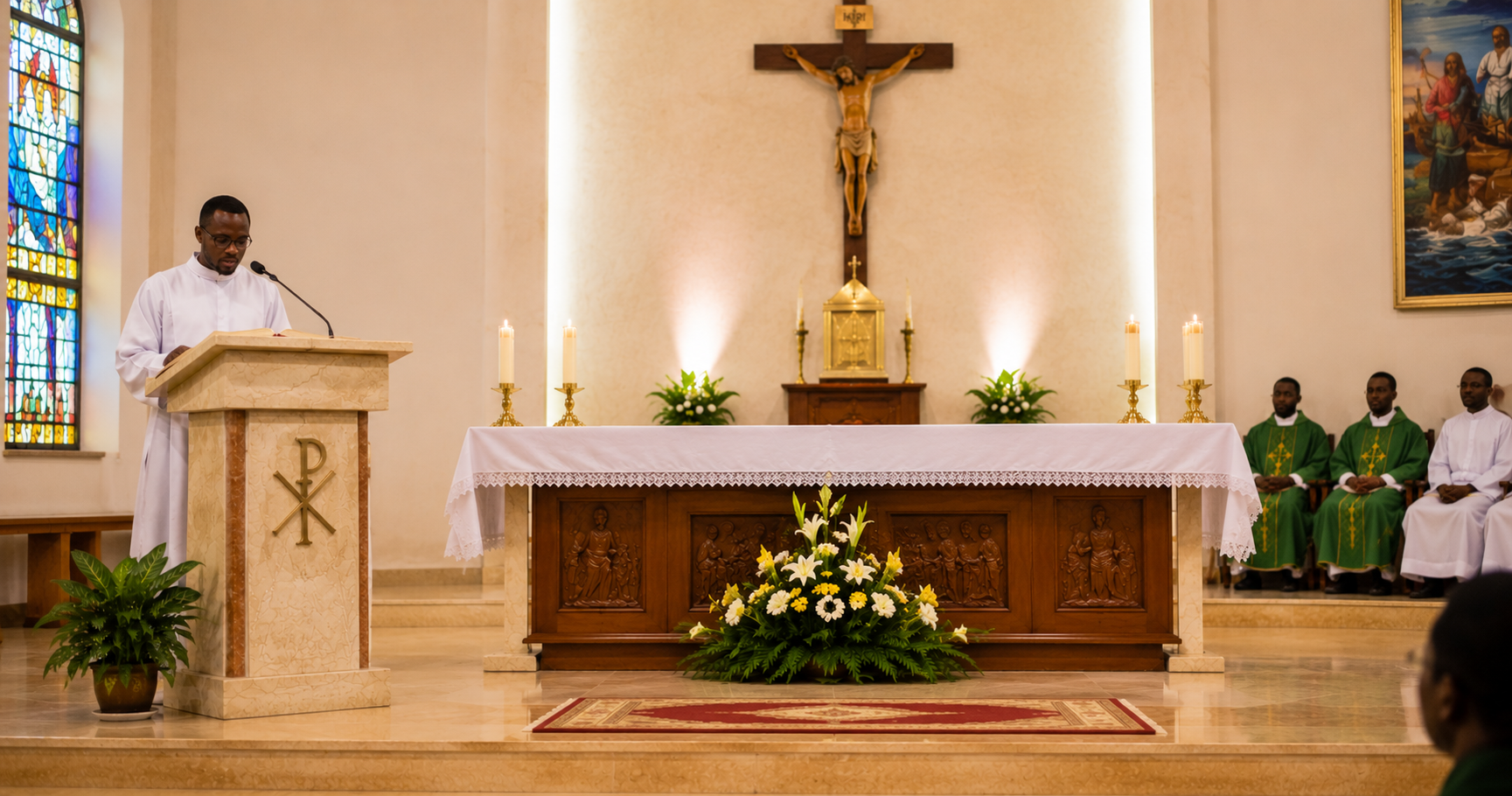
The Liturgy of the Word occupies a central place in the celebration of the Holy Mass. Through the proclamation of the Sacred Scriptures, God speaks to His people, who respond in faith and worship. The Church therefore gives great importance not only to the readings themselves but also to the place from which they are proclaimed. In many Catholic churches, the readings are proclaimed from a pulpit or ambo situated on the right side of the sanctuary. This architectural arrangement has given rise to the question: Why are the readings read from the right-side pulpit? The answer lies not in a universal legal requirement but in the Church’s theology of the Word of God, historical liturgical practice, biblical symbolism, and architectural tradition.
The Ambo: The Place of the Word of God
The Church’s liturgical theology emphasizes that the Mass consists of two inseparable parts: the Liturgy of the Word and the Liturgy of the Eucharist. The Second Vatican Council teaches: “The Church has always venerated the divine Scriptures just as she venerates the Body of the Lord” (Sacrosanctum Concilium, no. 51). This profound statement reveals that the Church nourishes the faithful at two tables: the Table of the Word and the Table of the Eucharist. Just as the altar is reserved for the Eucharistic sacrifice, the ambo is reserved for the proclamation of God’s Word. Christ is truly present in His Word when the Scriptures are proclaimed in the liturgical assembly (GIRM, no. 29). Hence, the Book of the Gospels is often carried in solemn procession and reverenced with incense and a kiss after the Gospel proclamation.
The Church distinguishes the ambo from an ordinary lectern. The ambo is a permanent and dignified place reserved primarily for the proclamation of the Sacred Scriptures. “The dignity of the Word of God requires that in the church there be a suitable place from which it may be proclaimed and toward which the attention of the faithful naturally turns during the Liturgy of the Word” (GIRM, no. 309). This means that the importance lies not in the side of the sanctuary but in the sacred character of the place. Since Christ Himself speaks whenever the Scriptures are proclaimed in the liturgy, the ambo must visibly express the dignity of the Word of God.
Likewise, the Introduction to the Lectionary teaches that the proclamation of Scripture is not simply the reading of a text but an act in which God addresses His people. Therefore, only the readings, the Responsorial Psalm, the Easter Proclamation (Exsultet), and the homily are ordinarily given from the ambo (Introduction to the Lectionary, nos. 32–34).
Furthermore, the Church requires is that the ambo be permanent and dignified; it be clearly visible and audible to the faithful; it be reserved principally for the proclamation of the Word of God;it direct the attention of the faithful toward the Scriptures being proclaimed (GIRM, no. 309).
Biblical and Historical Development of the Right-Side Ambo.
Notwithstanding the fact that, no universal liturgical law requires the ambo to stand on the right side of every church, many churches have traditionally placed it there because of biblical and theological symbolism.
Throughout Sacred Scripture, the right side signifies divine authority, blessing, honour, and victory. Christ is described as seated at the right hand of the Father (Mk 16:19; Acts 7:55–56). The Psalmist declares: “Your right hand, O Lord, glorious in power” (Exodus 15:6).
Similarly, Psalm 110:1 proclaims: “Sit at my right hand until I make your enemies your footstool.” Because the proclamation of Scripture is understood as the voice of Christ speaking to His Church, placing the ambo on the right side came to symbolize the authority and divine origin of God’s Word.
During the early centuries of Christianity, many basilicas contained two ambos, one for the Epistle and another for the Gospel. Over time, architectural styles evolved, and many churches retained only one principal ambo. In numerous medieval churches, the Gospel was proclaimed from the south (traditionally associated with the right side when viewed from the nave), symbolizing that the light of Christ was being carried to the nations. Although architectural customs differed between East and West, the symbolism of the right side remained influential in church design.
The Ceremonial of Bishops emphasizes that the ambo should be fixed, prominent, and suitable for the proclamation of God’s Word (Ceremonial of Bishops, nos. 136–141). It does not mandate its exact location within the sanctuary, leaving this to architectural judgment while preserving its dignity.
The Fathers of the Church frequently interpreted the right side as representing divine favour and eternal life. In his homilies on the Gospel of Matthew, Chrysostom interprets the right side as the place of honour and salvation: “The right hand is the place of honour, while the left signifies condemnation.” (John Chrysostom, Homily 79 on Mt 25:31–46). Consequently, medieval church architecture often reflected this symbolism by locating the ambo on the right side of the sanctuary.
Theological Significance for the Faithful
The placement of the ambo whether on the right or elsewhere, serves a deeper spiritual purpose. It reminds the faithful that God continues to speak to His people through the Sacred Scriptures. Every proclamation of the Word is an encounter with the living Christ. The Second Vatican Council beautifully expresses this reality: “Christ is present in His word, since it is He Himself who speaks when the Holy Scriptures are read in the Church” (Sacrosanctum Concilium, no. 7).Therefore, when the lector, deacon, or priest proclaims the readings from the ambo, the assembly is called not merely to listen but to receive God’s saving Word with faith, allowing it to transform their lives.
Conclusion
The practice of proclaiming the readings from the right-side pulpit is rooted in centuries of Christian symbolism rather than in a universal liturgical law. The right side traditionally signifies honour, divine authority, and the victorious reign of Christ, making it a fitting location in many churches for the proclamation of God’s Word. Nevertheless, the Church’s liturgical legislation focuses less on the physical location of the ambo than on its dignity and sacred purpose. Whether situated on the right, left, or centre of the sanctuary, the ambo remains the privileged place from which Christ speaks to His people through the Sacred Scriptures.


Leave a Reply