

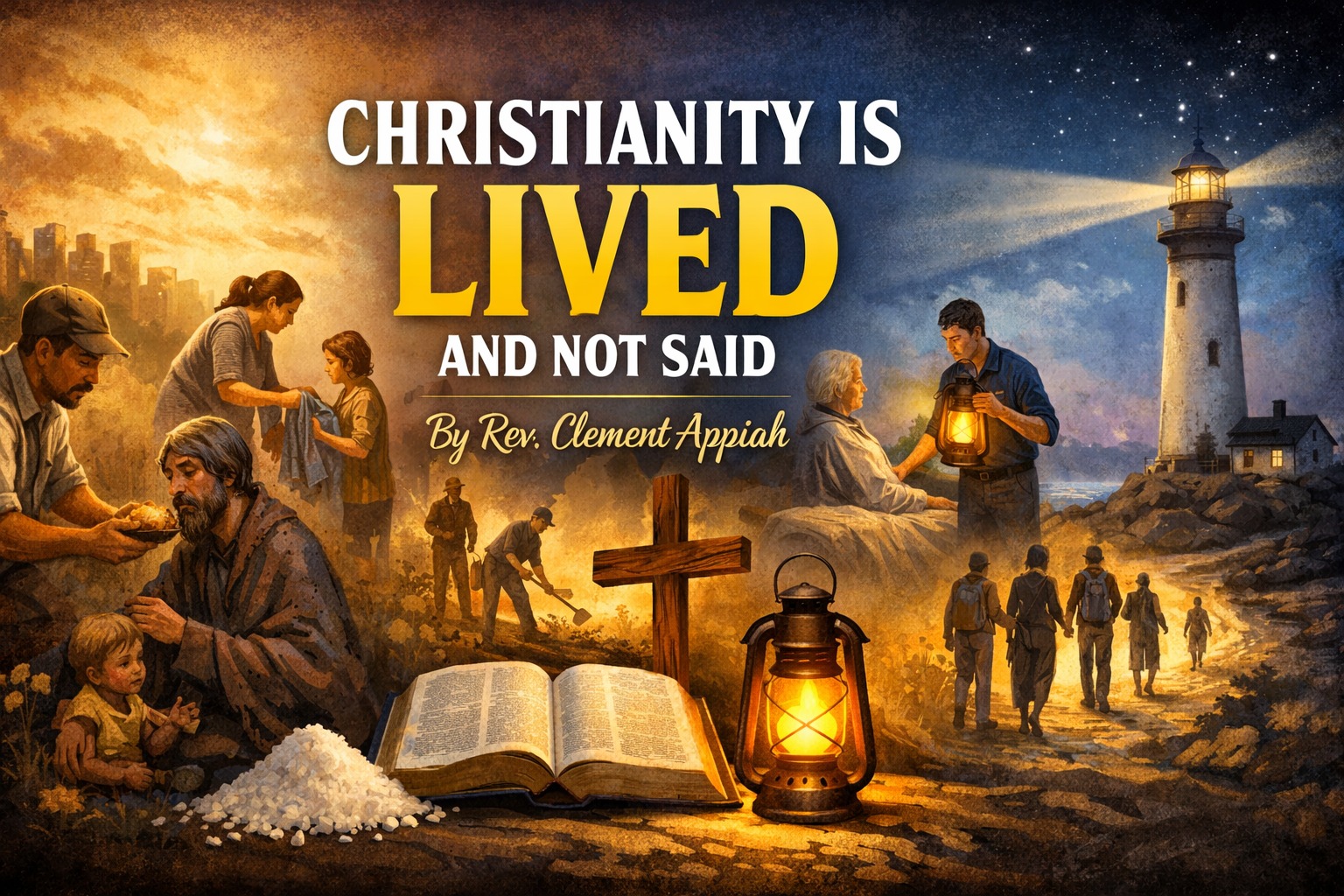
CHRISTIANITY IS LIVED AND NOT SAID
By Rev. Clement Appiah
It is very common for everyone to fill forms in order to register for a course or to make a National ID or something similar to that. On the regular form, there is a part which contains the bio-data of the person who fills the form. The bio-data contains the primary information of the person. It includes among other things; name, age, occupation, religion and the like. It is expected therefore, for anyone who fills the bio-data gives a true reflection of their life. If for instance, one is called McBrown, one cannot replace it with a name other than what is known.
Once McBrown is mentioned, the person is expected to own up to the name. So it is with the other primary pieces of information like age, occupation and the like. However, when it gets to the point when the fellow has to fill the part which asks about the person’s religion, they hurriedly write, “CHRISTIAN.” That is when one begins to betray him/herself. The question is, are we truly Christians as we claim or we just say it to get approval from people?
The desire to hurriedly say we are Christians or Muslims or people of other religions is so involuntary that we sometimes do not think twice. It is like someone saying, “I am a doctor or a policeman or a soldier” without having to verify twice or to ask further questions because their uniforms say so. The readings today tell us that Christianity is lived rather than said.
The First reading from Isaiah 58 belongs to the so-called Trito-Isaiah (Isa 56–66), addressing the post-exilic community. The people have returned from Babylon and are zealous about religious observance—fasting, prayer, and ritual—but social injustice, neglect of the poor, and oppression persist. They only lived by principles and neglected the fact that human beings are not robots but animate beings. Verses 7–10 form the positive core of the prophet’s critique. After condemning empty fasting (vv. 1–6), the prophet presents what true worship looks like: justice, compassion, and solidarity with the vulnerable.
Verse 7 speaks of Fasting as Concrete Mercy; “Is it not to share your bread with the hungry, and bring the homeless poor into your house; when you see the naked, to cover them, and not to hide yourself from your own kin?” This verse defines authentic fasting not as self-denial alone, but as self-giving love.
“Share your bread” emphasizes personal sacrifice, not surplus charity.
“Bring the homeless poor into your house” points to radical hospitality.
“Your own kin” widens responsibility from family to the covenant community—Israel cannot ignore its weakest members.
The theology here dismantles a privatized spirituality. Worship that ignores human suffering is false worship.
Verse 8 talks about Divine Response to Justice when it says, “then your light shall break forth like the dawn, and your healing shall spring up quickly…” The “then” is crucial. Divine blessing follows ethical conversion. Light symbolizes salvation, clarity, and restored relationship with God. Healing suggests both personal and communal restoration. “Your vindicator shall go before you” echoes Exodus imagery—God leads those who walk in justice. “The glory of the LORD shall be your rear guard” suggests protection and covenant faithfulness.
Verse 9 gives an assurance of restored Communion with God. It mentions “then you shall call, and the LORD will answer; you shall cry for help, and he will say, ‘Here I am.’” Previously, God seemed silent (cf. Isa 58:3). Now, ethical transformation restores dialogue. God’s response “Here I am” reverses Israel’s earlier complaint. Prayer becomes effective when it flows from a life aligned with God’s will. The text affirms that social sin blocks spiritual communion, while justice reopens it.
Verse 10 speaks of compassion as light in darkness: “If you offer your food to the hungry and satisfy the needs of the afflicted, then your light shall rise in the darkness…” Here compassion is framed as participation in God’s creative power. The needy are not objects of pity but recipients of dignity. Darkness turning to noonday suggests a complete reversal of despair. The community becomes a bearer of divine light to itself and others. This verse echoes later biblical themes of light overcoming darkness (cf. John 1:5; Matthew 5:14–16). It invites a spirituality where prayer becomes credible, fasting becomes fruitful, and faith becomes visible in love.
That is why the Gospel from Matthew 5:13-16 gives a concrete and authentic Christian life using the imagery of salt and light. Jesus invites us to live our lives in such a way that people may see and know that indeed we are Christians. In the ancient times, salt was not so common. It was given to people who had distinguished themselves as a reward for their hard work. Soldiers in particular were paid with salt at the end of the month because they played the crucial role of protecting the city from invaders and enemies. The Latin word for salt is salarium. It is the English derivative of “salary.” Salaries are given to people who have worked and it puts smiles on people’s faces.
That is what we should also endeavor to do; to put smiles on people. People should taste of our saltiness and walk in our lights. The Church has given us parameters to follow. The Church has given us the Corporal and Spiritual works of Mercy, some of which appear in the First reading.
CORPORAL WORKS OF MERCY SPIRITUAL WORKS OF MERCY
1. Feed the hungry Instruct the ignorant
2. Give drink to the thirsty Counsel the doubtful,
3. Shelter the homeless Admonish sinners
4. Clothe the naked Forgive offenses
5. Visit the sick Comfort the afflicted
6. Visit the imprisoned Bear wrongs patiently
7. Bury the dead Pray for the living and the dead
If we are able to practice the above, we would not even open our mouths to tell people we are Christians. By our own works, people will see the Christian tenets in us. If we fill forms indicating we are Christians, it will be a credible information we are putting across just as we write our true names.
However, the gospel says that those who live in contrast to their calling to be Christians are only nominal. Their Christian identity only exists in name and not in reality. The gospel compares them to salt which has lost its taste. They are thrown away because they are worthless and will have no use. Their lights are always buried and because they themselves live in the dark, they stumble. By extension, they cannot lead others. Can a blind man lead a blind man? Nemo dat quod non habet: you cannot give what you don’t have. To wit, one cannot give light if what he/she has is darkness.
To live an authentic Christian life, Paul says, let your wisdom rest in the power of God and not of men. Do not practice your Christian life so that people may see in order to applaud you. Do so to get God’s approval. This will cement the fact that our Christian lives are lived rather than said. We pray God then to send his Holy Spirit upon us so that we will show in our lives, the compassion God expects of us.
May goodness and kindness follow us all the days of our lives and may we live in the presence of God now and forever. Amen.
God bless you


Leave a Reply