

Inculturation of the Liturgical Calendar
From the rhetorical questions that concluded the Introductory part of this series, you may have realized that, rather than seeking to impose on the liturgy, individual idiosyncrasies such as jersey Sundays, earthenwear used as a thurible, ahenema (traditional slipper of the Akan people) as liturgical wear, collars as vestments, and the like under the guise of Inculturation, the concept of Inculturation properly pertains to serious and impactful issues that truly concern the faith and the people.
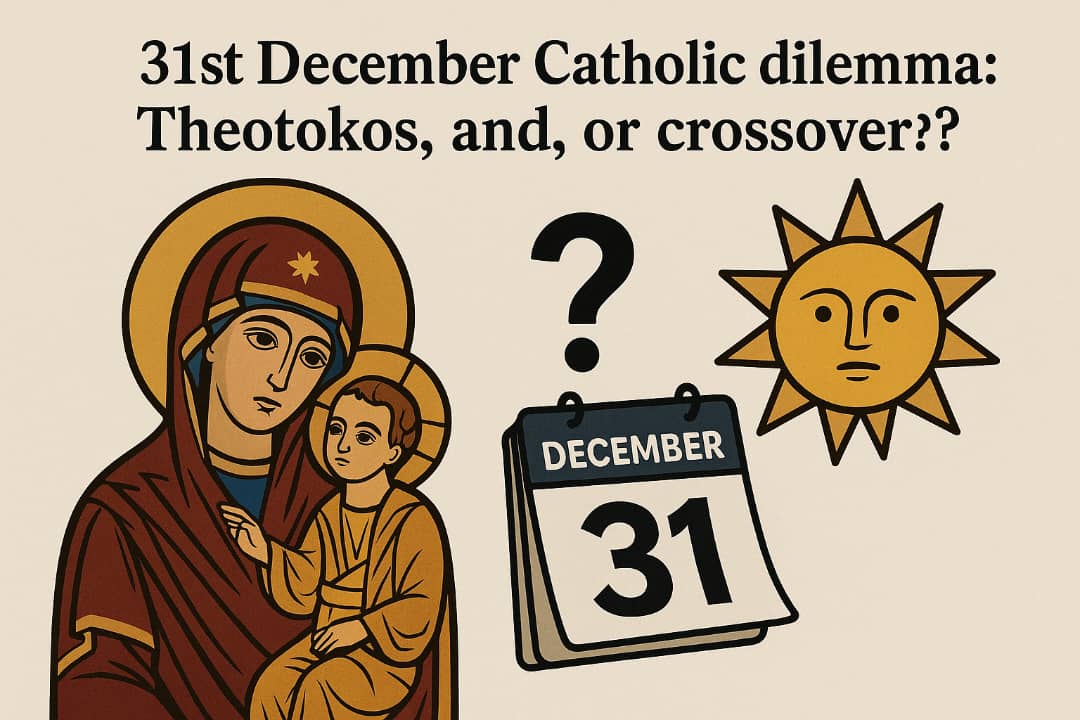
For instance, it involves competent and dispassionate questions such as whether the practice of keeping the faithful awake far into the night without a celebration of the Theotokos—resulting in fatigue and diminished attentiveness while still expecting them to fulfill their obligation toward the solemnity of the Theotokos—impedes the spirit and letter of the Church’s articulated principle (cf. CCC 2187). If it does, should escapism be considered an antidote to that challenge, or is a humble, courageous, prudent, and thoughtful form of Inculturation required to ensure that popular piety remains supportive of, and never competitive with, the primacy of the sacred liturgy?
Ceteris paribus, in the prevailing Christian climate of Ghana, the practice of the ’31st December Crossover’ is appreciated not only as a sacrifice of comfort (especially sleep) in thanksgiving to the Lord, who guides his people through a dying year and gracefully ushers them into a new one. But also, the practice strongly appears as an established, unavoidable, and generally non-contradictory expression of culture in relation to the substance of the Apostolic Faith.
In offering a perspective on inculturation as ‘a fresh approach to evangelizing people and cultures,’ Pope John Paul II, on 17th January 1987, advised: ‘when the Church enters into contact with cultures, she must welcome all that is compatible with the Gospel in these traditions of the peoples, in order to bring the riches of Christ to them and to enrich herself by the manifold wisdom of the nations of the earth.’
Indeed, even beyond this proper understanding of Inculturation and its possible application in the context at hand, the practice qualifies as what the Congregation for Divine Worship and the Discipline of the Sacraments designates as popular piety, if not as a pious exercise. According to the Directory on Popular Piety and the Liturgy: Principles and Guidelines (December 2001, 9), popular piety refers to ‘diverse cultic expressions of a private or community nature which, in the context of the Christian faith, are inspired predominantly not by the Sacred Liturgy but by forms deriving from a particular nation or people, or from their culture.’ Pious exercises, on the other hand, are described as ‘those public or private expressions of Christian piety which, although not part of the Liturgy, are considered to be in harmony with the spirit, norms, and rhythms of the Liturgy. Moreover, such pious exercises are inspired to some degree by the Liturgy and lead the Christian people to the Liturgy’ (Ibid, 7).
It is in this spirit that, apart from the four universally recognized mysteries (Joyful, Sorrowful, Glorious, Luminous) of the Rosary, Bishop William A. Wack of the Diocese of Pensacola-Tallahassee (Florida-USA) granted his imprimatur and Nihil Obstat on 22nd August 2024 for the local promotion of the ‘Hopeful Mysteries’”—Creation, the Great Flood, Abraham’s sacrifice, the Exodus, and the Immaculate Conception. These mysteries, originally conceived within the local community and subsequently evaluated as suitable for devotional use, were recommended to the faithful as a legitimate form of pious exercise.
In this contextual light, the seemingly established ‘31st December Crossover’ culture, if carefully reimagined, structured, and inculturated, could serve not as an obstacle, but as a sustaining and evangelical resource that supports the faithful in fulfilling the religious obligation of 1st January. Therefore, without prejudice to a possible transfer of the Solemnity of Mary, Mother of God, an important question arises to be confronted in the next release of this series: Are there significant liturgical or canonical precedents that would permit the Church either to adopt—or adapt—to the “31st December Crossover” culture within the life of the local Church?
To be continued…


Leave a Reply