


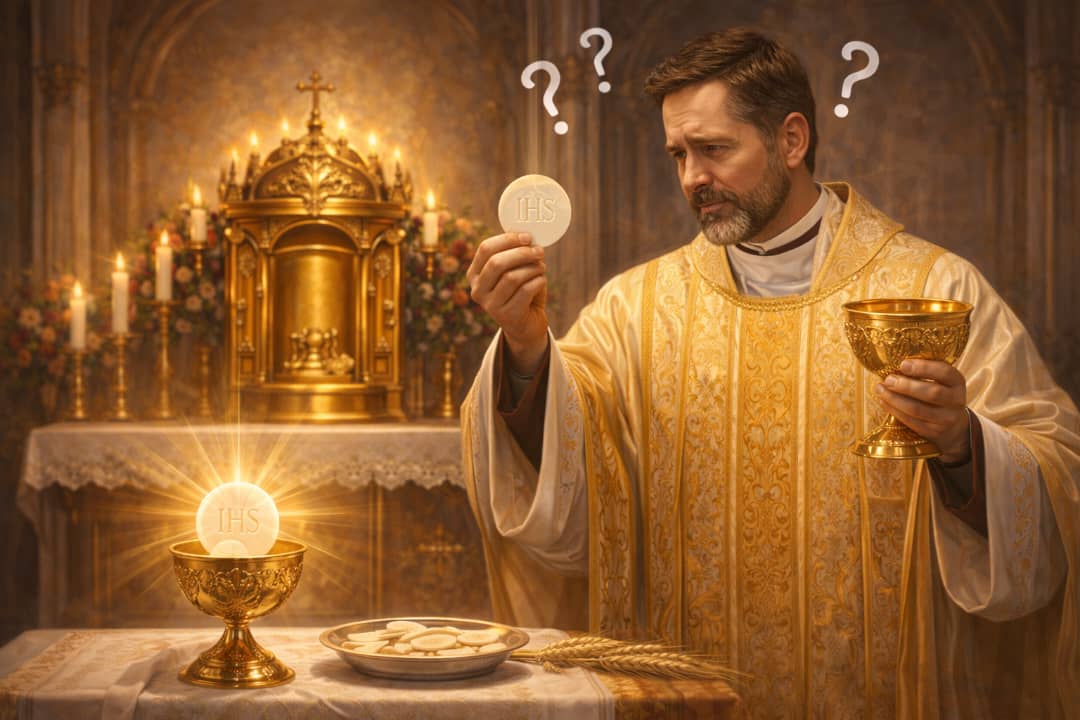
Over-consecration as a habitual practice is when priests consistently consecrate far more hosts than are needed for a given celebration, routinely distribute Holy Communion from the tabernacle, and consequently allow consecrated hosts to accumulate over time.
At the same time, it is important to recall the Church’s clear teaching regarding Eucharistic reservation: ‘It would be well to recall that the primary and original purpose of reserving the sacred species in church outside Mass is the administration of the Viaticum. Secondary ends are the distribution of Communion outside Mass and the adoration of our Lord Jesus Christ concealed beneath these same species’ [Eucharisticum Mysterium 49; Instruction Quam Plurimum 1; cf. Council of Trent, Session XIII, Decree on Eucharist, Chap. 6-Denz. 879 (1645); St. Pius X, Decree Sacra Tridentina Synodus 20. xii. 1905-Denz. 1981 (3375); cf. Inaestimabile Donum 20, 24-25)
Indeed, “‘the reservation of the sacred species for the sick … led to the praiseworthy custom of adoring the heavenly food which is preserved in churches. This practice of adoration has a valid and firm foundation,’ especially since belief in the real presence of the Lord has as its natural consequence the external and public manifestation of that belief” (Ibid).
Accordingly, ‘the sacred species are reserved after Mass principally so that the faithful who cannot be present at Mass, above all the sick and those advanced in age, may be united by sacramental Communion to Christ and his Sacrifice which is offered in the Mass.’ (Forward and no. 2 of Eucharistiae Sacramentum; Redemptionis Sacramentum 129; Holy Communion and Worship of the Eucharist Outside Mass 7). Therefore, reservation of the Blessed Sacrament in the tabernacle remains a precious and venerable practice of pastoral necessity, not because it is ideal for ordinary parish distribution. And even with the practice of pastoral necessity, the ‘Consecrated hosts are to be renewed frequently’ (CIC can. 939). Sound pastoral practice accordingly suggests, for example, a weekly rotation of hosts, with due regard for climate.
Flowing from these principles, the Second Vatican Council, in Sacrosanctum Concilium (55), preferentially affirmed: ‘that more perfect form of participation in the Mass whereby the faithful, after the priest’s communion, receive the Lord’s body from the same sacrifice, is strongly commended.’
Subsequent liturgical legislation has consistently reaffirmed this preference. Using the expression valde optandum (‘most desirable’) as technical liturgical language indicating normative preference rather than absolute obligation, the General Instruction of the Roman Missal (GIRM 85, 157, 243) teaches: ‘It is most desirable that the faithful, just as the priest himself is bound to do, receive the Lord’s Body from hosts consecrated at the same Mass and that, in the instances when it is permitted, they partake of the chalice, so that even by means of the signs, communion will stand out more clearly as a participation in the sacrifice actually being celebrated’ (Instructions: Eucharisticum Mysterium 31-32; Immensae caritatis 2).
When over-consecration is practiced habitually, however, the sign value of the Eucharist is weakened. Holy Communion can appear detached from the sacrifice just offered. It is tempting to conclude that “people do not notice or care,” forgetting that many liturgical signs work precisely because they are subtle yet consistent. As the Church teaches, the faithful are formed not only through explanation but also through repeated liturgical practice (Sacrosanctum Concilium, 59). Over time, habits shape belief (lex orandi, lex credendi). When this pattern exists, when consistently done, the faithful may perceive Mass as incomplete without ‘stored’ hosts, and as against what the Church teaches (Inter Oecumenici, 91; Eucharisticum mysterium 24; GIRM 73) the tabernacle subtly replaces the altar as the focal point of Eucharistic life.
In response to widespread abuses, the Congregation for Divine Worship and the Discipline of the Sacraments stated unequivocally in Redemptionis Sacramentum (85): ‘Care should be taken that hosts are consecrated only in the number required for the faithful.’ This directive is not merely theological but also scientific, rational, and prudential in nature. Theologically, the concern is not what is received—since Christ is fully present in every validly consecrated host—but how clearly the Eucharistic sacrifice is expressed sacramentally. The Church’s preference thus concerns sacramental sign value, not sacramental reality (cf. GIRM 85; SC 55).
From a scientific and practical standpoint, bread is perishable matter. Although the Eucharist is substantially the Body of Christ, the Church teaches that the accidents of bread remain (CCC 1376) and are therefore subject to natural deterioration. Experience confirms that hosts kept for prolonged periods may absorb moisture, become brittle or stale, develop mold (especially in humid climates), or allow microbial growth even in low-moisture conditions. Debatably, in such circumstances, St. Thomas Aquinas teaches: ‘the sacrament ceases to exist when the accidents no longer retain the nature of bread’ (Summa Theologiae, III, q.77, a.4). Simply put, if the matter corrupts, the sacrament ceases, raising grave pastoral and devotional concerns.
Admittedly, legitimate concerns arise in situations where the number of communicants is difficult to anticipate, particularly during diocesan or national celebrations. In such cases, it is often argued that ‘it is safer to consecrate extra than to run out.’ While prudence is indeed necessary, it must be accompanied by proportion. A modest surplus respects both reverence for the Eucharist and the Church’s liturgical intention (Redemptionis Sacramentum, 85).
In conclusion, the Church does not forbid the reservation of the Eucharist, the distribution of Holy Communion from the tabernacle, or the keeping of a reasonable number of consecrated hosts on hand. She does, however, clearly teach and prefer that:
- the faithful ordinarily receive hosts consecrated at the Mass they attend,
- habitual over-consecration be avoided,
- the tabernacle serves pastoral necessity and Eucharistic adoration, not routine convenience,
- and consecrated hosts be renewed frequently out of reverence and prudence.
Expectedly, this principle should guide liturgical planning, even when exceptions are necessary. Those in charge of the preparation of the hosts can do well by estimating the number of hosts by tracking or having a fair idea of the average Mass attendance per Mass time, prepare hosts according to typical attendance and seasonal fluctuations (holidays, school year), add a small margin (e.g., 5–10%), not a large but modest surplus that can immediately be consumed.



Leave a Reply