

The Homily?
In virtue of their baptism, all the members of the People of God have become missionary disciples (cf. Mt 28:19). All the baptized, whatever their position in the Church or their level of instruction in the faith, are agents of evangelization, and it would be insufficient to envisage a plan of evangelization to be carried out by professionals while the rest of the faithful would simply be passive recipients. The new evangelization calls for personal involvement on the part of each of the baptized. Every Christian is challenged, here and now, to be actively engaged in evangelization; indeed, anyone who has truly experienced God’s saving love does not need much time or lengthy training to go out and proclaim that love (Evangelii Gaudium 120; Catechism of the Catholic Church [CCC] 888–892).
Particularly however, ‘sacred ministers, among whose principal duties is the proclamation of the gospel of God to all, are to hold the function of preaching in esteem since the people of God are first brought together by the word of the living God, which it is certainly right to require from the mouth of priests (CIC Can. 762). Therefore, associated with the Part I (liturgy of the word) of the Mass is ‘homily’ which under the broad subject of Preaching (any proclamation of the Word of God intended to teach, exhort, or evangelize), is a major facilitator of the Church’s evangelistic mission. Although recommended on other days, there is to be a homily on Sundays and holy days of obligation at all Masses that are celebrated with the participation of a congregation; it may not be omitted without a serious reason (cf. Inter Oecumenici 53; General Instructions of the Roman Missal [GIRM] 66; SC 52).
As Inter Oecumenici (54) makes known, ‘a homily on the sacred text means an explanation, pertinent to the mystery celebrated and the special needs of the listeners, of some point in either the readings from sacred Scripture or in another text from the Ordinary or Proper of the day’s Mass.’ Among the forms of preaching, the distinctive nature of homily lies in the fact that it is ‘highly esteemed as part of the liturgy itself’ (SC 52; Can. 767 §1; Redemptionis Sacramentum [RS] 64; GIRM 65; Sacramentum Caritatis 46).), reserved to a priest or deacon, and never to a layperson (the prohibition applies to seminarians, students of theological disciplines, and those who have assumed the function of those known as ‘pastoral assistants;’ nor is there to be any exception for any other kind of layperson, or group, or community, or association- cf. RS 66; GIRM 66; Code of Canon Law, can. 6, §1, 2; 767 §1; Ecclesiae de Mysterio 3 § 1; GIRM 66).
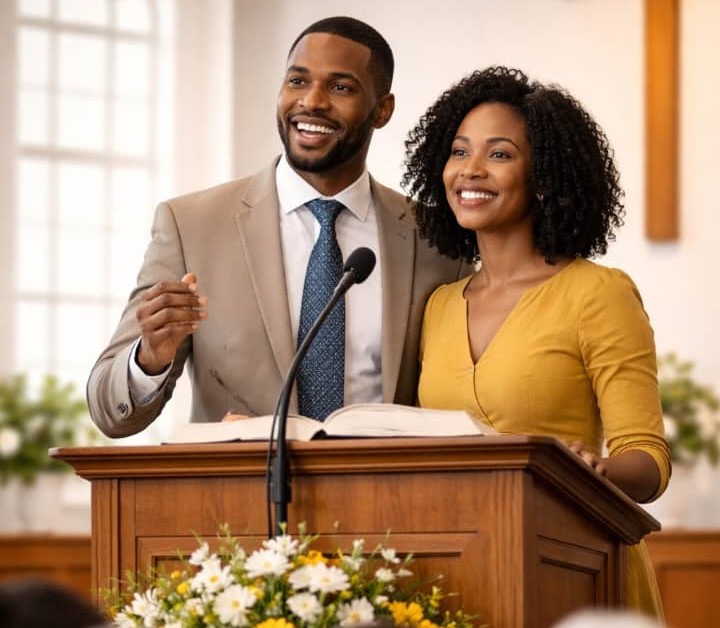
Primarily, although the fact of the homily as a preserve of the clergy flows from the ministerial priesthood, which differs in essence (not just degree) from the common priesthood of the baptized (cf. Lumen Gentium 10), it is also informed by it’s connection to the official teaching authority (munus docendi) that comes with Holy Orders, and the intrinsic unity of both the Liturgy of the Word and the Liturgy of the Eucharist which uniquely forms the Mass; one single action, and the two are distinct, yet intertwined and inseparable (GIRM, 28). Although these two may be celebrated in other liturgical settings individually, the Table of the Word and the Table of the Eucharist are not independent of each other in the Mass. Is it wrong then for an experienced married couple to give ‘homily’ on the feast of Holy Family?
Pastoral Sensitivity on Days Like the Feast of the Holy Family?
As instituted by Pope Leo XIII through a decree by the Sacred Congregation of Rites in 1893 and later made universal by Pope Benedict XV in 1921, the feast of Holy Family is to emphasise family life, with the Holy Family of Jesus, Mary and Joseph as the perfect example. As often argued, is it not proper and practical, therefore, that married couples who live that vocation be given the space to give ‘homily’ on ‘family occasions like the feast of the Holy Family?
In the case of the feast of Holy Family where pastoral (re)considerations may be needed, the Church already addresses such instances by stating that: ‘If the need arises for the gathered faithful to be given instruction or testimony by a layperson in a Church concerning the Christian life, it is altogether preferable that this be done outside Mass. Nevertheless, for serious reasons it is permissible that this type of instruction or testimony be given after the Priest has proclaimed the Prayer after Communion. This should not become a regular practice, however. Furthermore, these instructions and testimony should not be of such a nature that they could be confused with the homily, nor is it permissible to dispense with the homily on their account (Redemptionis Sacramentum 74; Ecclesiae de mysterio, Practical Provisions, art. 3 §2).
The following considerations may also be made:
- By the fact of their sacred ordination and by the entrustment of the principal celebrant, married deacons may be entrusted with the homily in parishes they exist.
- In anticipation of the celebration of the Feast of the Holy Family, a lay person may be entrusted to preach in accordance with the norm of law and provided the conditions of Canon 766 of the Code of Canon Law are met, at the first vespers of the said Feast.
- A seminar on family life may be organised by the parish outside of Mass where “experts” may be invited to give a talk about family life.
In sum, the strict association of homily to ministerial priests, and as a ‘privilege’ to deacons for instance, is not about holiness, intelligence, or ability, but about the essence of ordination and sacramental roles. Hence, the ‘Ordinary’ for a homily is recognized as the principal celebrant of the celebrated Mass, not necessarily a concelebrating Priest, a Deacon, or even a Bishop or a Priest who is present at the celebration but cannot concelebrate (cf. GIRM 66; RS 64; Code of Canon Law, can 767 §1). Again, by the virtue of filial obedience, the norms of the Constitution on sacred liturgy by the Sacred Council of Vatican II must be obeyed, thus: In liturgical celebrations each person, minister or layman, who has an office to perform, should do all of, but only, those parts which pertain to his office by the nature of the rite and the principles of liturgy (SC 28).
Authors
- Padmond Afrane Owusu
- Rev. Fr. Samuel Atta Okyere


Leave a Reply