

THE BEGINNING OF THE TRIDUUM
Rev. Prince Peprah
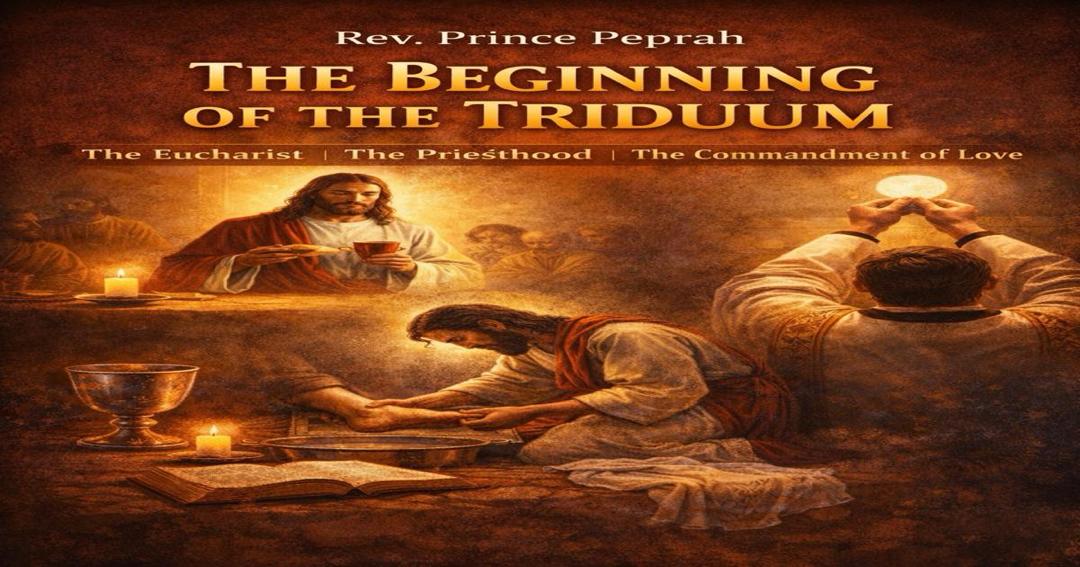
Dear people of God, we celebrate this evening one of the most profound evenings in the life of the Church, the beginning of the Sacred Triduum, a sacred moment of the Passion and Resurrection of our Lord, which shines forth as the high point of the Church’s life and entire liturgical year. The Roman Missal puts the paschal Triduum from the beginning of the Holy Thursday evening Mass, traditionally called, “Mass of the Lord’s Supper”, and it reaches its high point in the Easter Vigil and closes with evening prayer on Easter Sunday. Tonight, we celebrate and contemplate on three great gifts that Jesus gave to His Church: The gift of the Holy Eucharist, the gift of the ministerial Priesthood and the gift of the new commandment of love.
The roots of tonight’s celebration go back to the first Passover in the Book of Exodus, which serves as our first reading for today. The People of Israel were to sacrifice a lamb without blemish and mark its blood at their doorposts with its blood. On that night, the Lord was to spare all who partook in this sacred act from His strike, saving them from death. This followed a command to eat the flesh of the lamb that night, roasted, with unleavened bread and bitter herbs. This day was to be a memorial day and it was to be kept as a feast to the Lord by every generation.
Tonight, we see this passover finds its fulfillment in Jesus. For this, Pope Benedict XVI, in his Easter Homily, in the year 2009 notes that “Jesus brought to fulfillment the tradition of the ancient passover, and transformed it into His Passover”. He further notes that “Jesus did not simply eat the Jewish Passover as it was, but offered himself as the true Lamb, thus, bringing the ancient Passover to fulfillment in his own Paschal sacrifice. The lamb became Christ and by shedding His blood, He saved humanity from the slavery of sin and death.
In the Second Reading from the First Letter to the Corinthians, Saint Paul recounts what Jesus did at the Last Supper. He took bread, blessed it, broke, and gave it to His disciples, saying: “This is my body”. It was a moment in which Jesus did not just share a meal but gave Himself. This marks the institution of the ministerial Priesthood when Jesus says “Do this in memory of me”. In those words, Christ entrusted His mission to His Apostles and their successors. (CCC nos. 1323- 1324). The Priesthood there and then gained its scope; being about service, sacrifice and self-giving love and not about status and honor. (Presbyterorum Ordinis nos. 2-6). Paul further reminds us that this had been the living tradition of the Church from the very beginning.
Moreover, the sequence of the first and second readings may naturally lead us to expect the Gospel emphasizing the bread of life discourse of John. Instead, we are given something unexpected. Jesus kneeling and washing the feet of his disciples. A work which was customary meant for servants, slaves, and the lowest-ranking members of a household. This was so because of some cultural, social, religious and practical reasons. For practical reasons, people in ancient Israel walked distances, wore open sandals, traveled on dusty, unpaved roads. Roads were shared with Donkeys, Camels and even Sheep. Consequently, animal dung was common along pathways and people walking would inevitably step in or brush against. As a result, feet became extremely dirty due to a mixture of dirt, sweat, animal dung and sometimes wounds. In a society where washing of feet was a symbolic gesture, Masters left it in the hands of their servants. For the religious reasons, in Jewish thought, contact with dirt and bodily impurity could carry ritual overtones risking one to defilement. Some rabbinic traditions even suggest that a jewish slave was even exempted from this task, leaving it to non- Jewish slaves. Peter’s reaction, refusing at first, shows how shocking this was. A master, let alone one regarded as Lord, going too low to do this. Yet the Master, the Lord, the Son of God, takes the towel and the basin to wash His disciples’ feet. Instead of Jesus becoming defiled by what is unclean, He rather cleanses and sanctifies through His love.
Dearly beloved, Jesus washing of feet calls us to humble service. A call to sacrificial sharing. We cannot come to the Altar, receive the Body and Blood of Christ, and then refuse to love, refuse to forgive, refuse to serve. The Eucharist transforms us into what we receive. This is not a suggestion but an example given by Jesus to emulate. It is for this reason that this day is called “Maundy Thursday”. For on this day, Christ gave a “mandatum” (a latin word for Command). A new commandment to love one another as He has loved us. A commandment of Service and love.
As we continue today’s Mass and come forward to receive Holy Communion, let us ask ourselves: Whose feet am I being called to wash? Who in my life needs my patience, my forgiveness, my service? Am I ready to also give myself in return like the One I am receiving?


Leave a Reply