

By Daniel Nimoh-Boateng
One of the commonly asked questions that Catholics always have to answer is “why do you use incense in worship?” Using incense in Christian worship is not a novelty. It happens to be one of the most ancient practices that is deep in symbolism and has been preserved in the Catholic liturgical tradition. It is enshrined deeply in Sacred Scripture. In the Old Testament, Moses received the command from God to prepare incense for worship (Cf. Exodus 30:7-8). Incense, therefore, was connected with divine worship, reverence, sacrifice, and prayer. The Psalmist affirms this when in 141:2 he prays: “Let my prayer rise before you as incense.” In the New Testament, this symbolism is again taken up as described especially in the heavenly liturgy in the Apocalypse (Cf. Revelation 8:4).
This biblical symbolism is what the Catholic Church has conserved in her liturgical life. The General Instruction of the Roman Missal (GIRM) teaches that “The use of incense is an expression of reverence and of prayer, as is signified in Sacred Scripture” (GIRM, no. 276). It follows then with logical precision that the burning of incense in the liturgy implies reverence and honor offered to God, purification and sanctification, the prayers of the faithful ascending to heaven and the sacredness of persons and objects dedicated to divine worship. Consequently, incense is not merely ornamental or ritualistic. More than being just that, it is a theological and liturgical act that expresses adoration, sanctification, and solemnity.
The question of the elements that can be incensed then becomes a reality. The Roman Rite stipulates that various persons and sacred objects may be incensed during liturgical celebrations. To this effect, the General Instruction of the Roman Missal (277) specifies these clearly: the Altar, the Cross, the Book of the Gospels, the Gifts of Bread and Wine, the Priest, the Faithful, the Blessed Sacrament, Sacred Images and Relics.
According to the provisions made in the Roman Rite, there are several moments when incense may be used during Mass. These include the entrance procession (Cf. GIRM 49, 123), before the proclamation of the Gospel (Cf. GIRM 132-134), during the preparation of the gifts (Cf. GIRM 75, 144, 277). This is where our interest lies today.
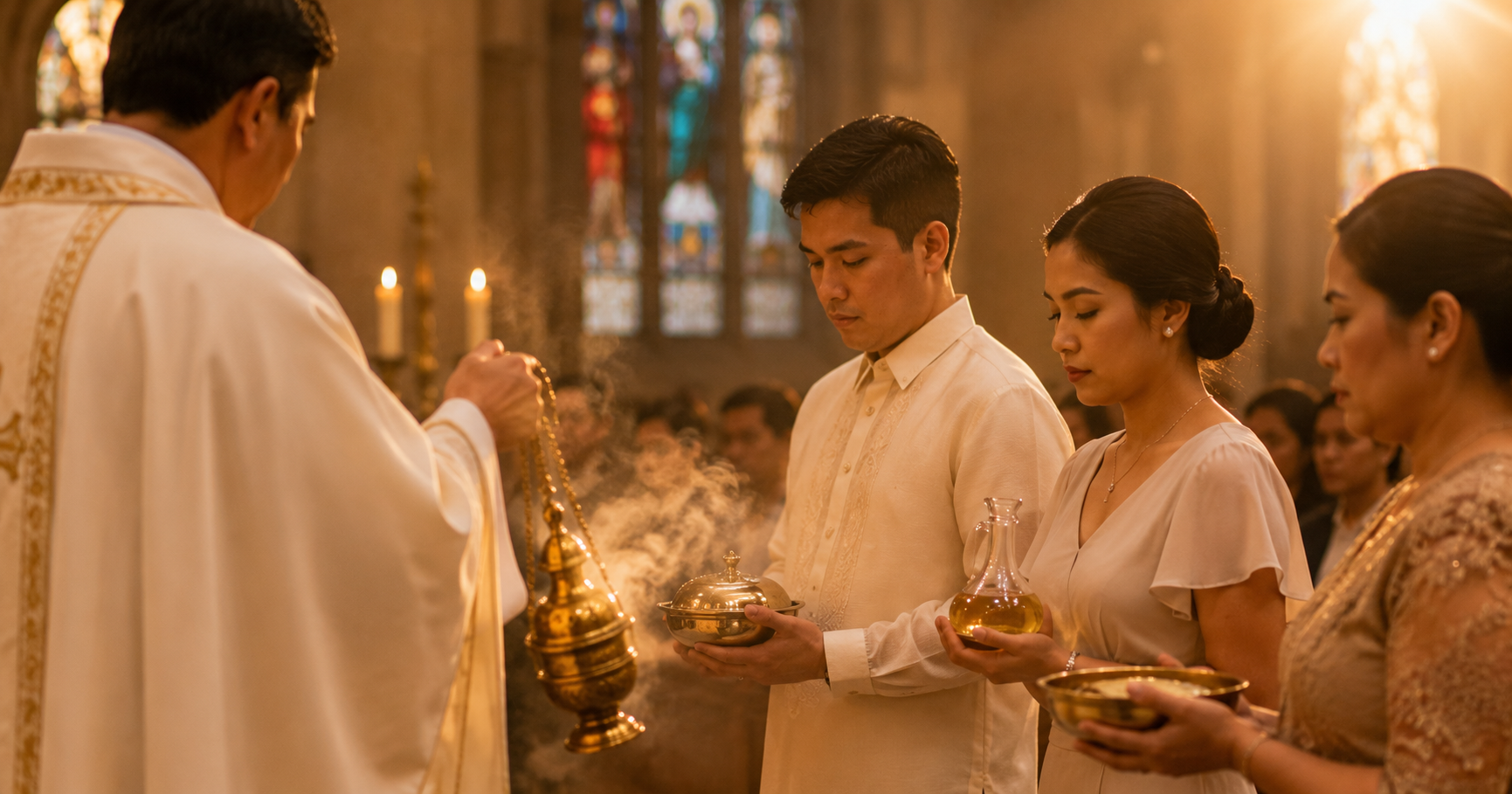
It is obviously one of the most important incensations during the Mass. After the reception of the gifts, the bread and wine are positioned on the altar, and the other gifts are put in an appropriate place away from the Eucharistic table (Cf. GIRM 73, 140), and then the priest after putting incense into the thurible and blessing it silently proceeds with the incensation.
The million-dollar question arises then: what exactly is incensed here? We have already in the previous paragraphs come to terms with items that can be incensed as given by the GIRM. Which items among the many mentioned above are eligible for incensation here and when? At this stage of the Mass, the following are incensed: the bread and wine prepared for sacrifice, the altar cross, the altar itself, the priest, and the faithful. This order is itself symbolic because the liturgy first honors the sacrificial gifts and the altar where the sacrifice will occur.
One question that has left a lot of people thinking is whether or not the faithful carrying the gifts are to remain before the altar while the gifts are incensed. The liturgical books do not in any way prescribe that the bearers of the gifts themselves are incensed at that moment simply because they carried the offerings. Rather, the incensation concerns the offerings after they have been placed upon the altar. Number 73 of GIRM states: “First, the altar, or Lord’s table, which is the center of the whole Liturgy of the Eucharist, is prepared…”
This implicitly reveals that technically speaking, gifts are not liturgical offerings once they have not been received by the priest or deacon and placed on the altar; the gifts become liturgical offerings once they are received by the priest or deacon and placed upon the altar.
Consequently, the normal Roman practice as enshrined in the liturgical books is that the faithful bring forward the bread and wine, the priest or deacon receives them, the bearers withdraw, the gifts are arranged on the altar and then the priest incenses the offerings on the altar (Cf. GIRM 73-75). The gifts are not to be incensed while not on the table of sacrifice. The liturgical books acknowledge the incensation of the bearers of the gift during the incensation of the faithful which happens after the sacrificial gifts, the table of sacrifice (altar), and the priest acting in persona Christi capitis are incensed.
We can proceed by making mention of the fact that once there is the reception of the gifts by the priest, the gifts become part of the liturgical action of the altar (Cf. GIRM 73). The reality of this shifts the attention from the bearers of the gifts to the sacrificial reality the gifts signify. Furthermore, the GIRM distinguishes clearly between objects incensed (gifts, altar, cross, book of the Gospels) and persons incensed because of ecclesial dignity (priest and faithful). Gift bearers are not in any way singled out for incensation as individual ministers. In addition to the above, the Roman Rite consistently emphasizes that the Eucharistic sacrifice is centered upon the altar, not upon the procession itself (GIRM 73).
Incensation in the Catholic rite is a great act of worship rooted in Sacred Scripture and preserved through centuries of liturgical tradition. Far from being merely ritualistic and/or ceremonial, it expresses reverence, sanctification, sacrifice, and prayer.
The Roman Rite carefully regulates when and how incense is used so that the symbolism remains clear and dignified. During the Preparation of the Gifts especially, the Church directs attention toward the altar and the sacrificial offerings rather than toward the individuals presenting them. Thus, the gifts are ordinarily incensed after they have been placed upon the altar (Cf. GIRM 276), and the gift bearers are not required to remain standing before the altar holding them during the incensation.
SOME SELECTED BIBLIOGRAPHY
Catholic Church. General Instruction of the Roman Missal. Washington, DC: United States Conference of Catholic Bishops, 2011.
Catholic Church. Ceremonial of Bishops. Collegeville, MN: Liturgical Press, 1989.
Second Vatican Council. Sacrosanctum Concilium (Constitution on the Sacred Liturgy). In Vatican Council II: The Conciliar and Post Conciliar Documents, edited by Austin Flannery, vol. 1, 1-66. Northport, NY: Costello Publishing, 1975.



Leave a Reply