

Introduction
Sacramentals occupy an important place in the life of the Church. Instituted by the Church, they are sacred signs that prepare the faithful to receive grace and sanctify various circumstances of life. Among these, holy water is one of the most widely used and accessible sacramentals. However, its misuse often rooted in misunderstanding or carelessness raises serious theological and pastoral concerns. In particular, the abuse, playing with, or making light of sacramentals like holy water as sometimes seen in practice must be addressed clearly. Such actions undermine the sacred character of what the Church has set apart for divine worship and sanctification. These matters must be approached with seriousness, especially on the part of ministers who are entrusted with safeguarding the Church’s liturgical and devotional life.
The Nature and Purpose of Sacramentals
According to the Catechism of the Catholic Church (nos. 1667–1670), sacramentals are sacred signs instituted by the Church to sanctify different situations of life. They do not confer grace in the same way as the sacraments but dispose the faithful to receive grace and cooperate with it. The Catechism emphasizes that sacramentals derive their efficacy from the prayer of the Church – not from any magical or automatic power. Misunderstanding this leads either to superstition or to trivialization.
Similarly, the Sacrosanctum Concilium (no. 60) teaches that sacramentals signify spiritual effects obtained through the intercession of the Church. Therefore, their use must always reflect faith, reverence, and proper intention.
Holy Water: Meaning and Proper Use
Holy water is a sacramental blessed by a priest or deacon. Its significance includes: reminding the faithful of their Baptism, signifying purification and renewal, and invoking God’s protection and blessing
The Book of Blessings highlights that holy water should be used with devotion and dignity, whether in personal prayer or in liturgical rites. Holy water must be blessed properly and used with prayer and reverence.
The General Instruction of the Roman Missal (GIRM, no. 51) permits the Rite of Blessing and Sprinkling of Water, especially on Sundays, as a reminder of Baptism and the purification associated with Christian life. The sprinkling of holy water within the liturgy belongs to the celebrant and not any other person according to GIRM no. 51. Therefore, holy water is to be treated as a sacred sacramental and not approached casually or irreverently. Because of this rich meaning, holy water is not ordinary water. It is a sacred sign that demands reverence.
The Abuse of Holy Water
Treating holy water as if it works mechanically or magically is a distortion of its meaning. The Catechism of the Catholic Church (no. 2111) condemns superstition as a misuse of religious practices.
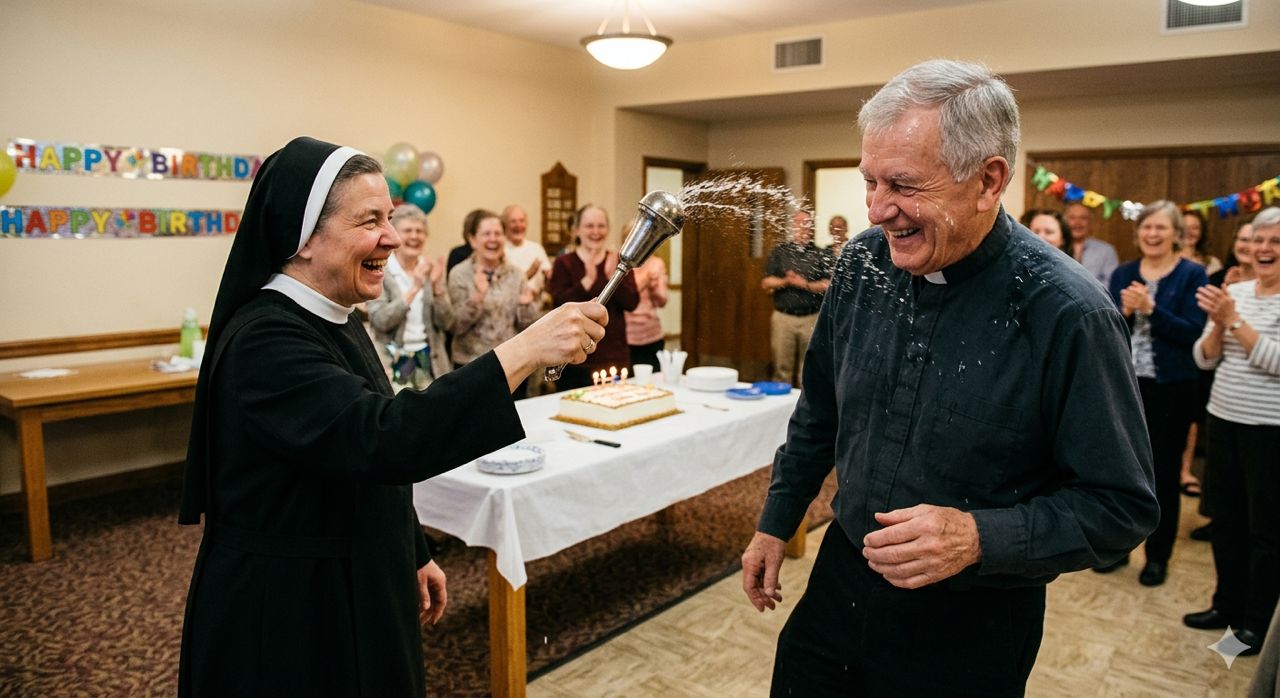
A serious and increasingly visible abuse is the tendency to play with holy water or to treat it lightly. Splashing it casually, using it jokingly such as sprinkling it on another just for fun, or turning its use into a spectacle strips it of its sacred dignity. As rightly noted, the abuse, playing with, and making light of sacramentals like holy water must be approached with seriousness. This concern is even more urgent when such behavior is seen among those who exercise ministry. Clerics and those entrusted with liturgical roles have a grave responsibility to model reverence. When they themselves treat sacramentals lightly, they risk leading the faithful into misunderstanding and irreverence. These are not trivial matters. Holy water recalls the mystery of Baptism and the saving work of Christ; therefore, it cannot be reduced to entertainment or casual gesture.
Careless handling, poor maintenance of holy water fonts, or failure to preserve the dignity proper to sacramentals by ministers or other lay faithful constitute an abuse, since the Church teaches that sacred objects dedicated by blessing are to be treated with reverence and must not be used in a profane or inappropriate manner (Canon 1171). This shows that improper or irreverent use of holy water is not just bad practice – it goes against Church law.
The Responsibility of Ministers
The Church places particular responsibility on ministers to ensure that sacramentals are used properly. The Redemptionis Sacramentum (no. 11) insists that no one may introduce practices based on personal preference in sacred matters. This principle applies equally to sacramentals. Ministers must not trivialize, improvise, or dramatize their use in ways that obscure their meaning. Rather, they must approach them with seriousness, fidelity to the Church’s norms, and a deep sense of the sacred.
Conclusion
Holy water is a profound sign of God’s grace, rooted in the mystery of Baptism and sustained by the prayer of the Church. Yet, when it is abused – whether through superstition or by playing with it and making light of it – its meaning is obscured and its dignity diminished. Such misuse must be taken seriously, especially by ministers, whose example shapes the faith of the people. A renewed fidelity to the teachings of the Catechism of the Catholic Church, Sacrosanctum Concilium, and the Church’s liturgical norms will help restore a proper understanding. Holy water is not for amusement. It is a sacred sign. It must be approached and used with reverence, faith, and seriousness.





Leave a Reply