

Introduction
The Paschal Candle stands as one of the most profound liturgical symbols in the Roman Catholic tradition, representing the Risen Christ as the Light of the world. Its prominence is especially evident during the Easter Vigil and throughout the Easter season. However, the question of whether – and when – it should be incensed is not always clearly understood. This article examines the liturgical norms governing the incensation of the Paschal Candle, clarifying both the explicit prescriptions of the Church’s liturgical books and the theological rationale that underlies the practice.
The Liturgical Significance of the Paschal Candle
The Paschal Candle symbolizes the Risen Christ, the true “pillar of fire” who dispels the darkness (cf. Ex 13:21). According to the Roman Missal, it is solemnly blessed and lit during the Easter Vigil and remains in a place of honor – near the ambo or altar – throughout the Easter season. The candle is not merely decorative; rather, it is a sacramental sign of Christ’s living presence, especially in: the Easter Vigil, the liturgies of the Easter season, Baptisms, and Funerals. Its use highlights the central mystery of the Resurrection and the ongoing presence of Christ among His people.
A Crucial Theological Principle: Multiple Signs, One Christ
It is rightly noted that: the altar, the crucifix, and the Paschal Candle all signify Christ, but in different modes: • The altar signifies Christ as priest, victim, and altar of sacrifice. • The crucifix signifies Christ in His Passion. • The Paschal Candle signifies Christ risen and glorified, the Light of the world. These are not interchangeable symbols. The Roman liturgy carefully orders their prominence depending on the mystery being celebrated.
The Relationship Between the Paschal Candle and the Crucifix
A further theological and symbolic consideration arises when the Paschal Candle is incensed alongside the crucifix. The Paschal Candle represents the Risen and glorified Christ and the Crucifix represents the suffering and crucified Christ. Simultaneous incensation of both may create a duplication of symbolic emphasis or even suggest a tension between Resurrection and Passion, if not properly understood.
Moreover, the liturgical norms are clear that the crucifix is to be incensed whenever incense is used. Therefore, the crucifix can never be omitted in favor of the Paschal Candle.
Incensation at the Easter Vigil
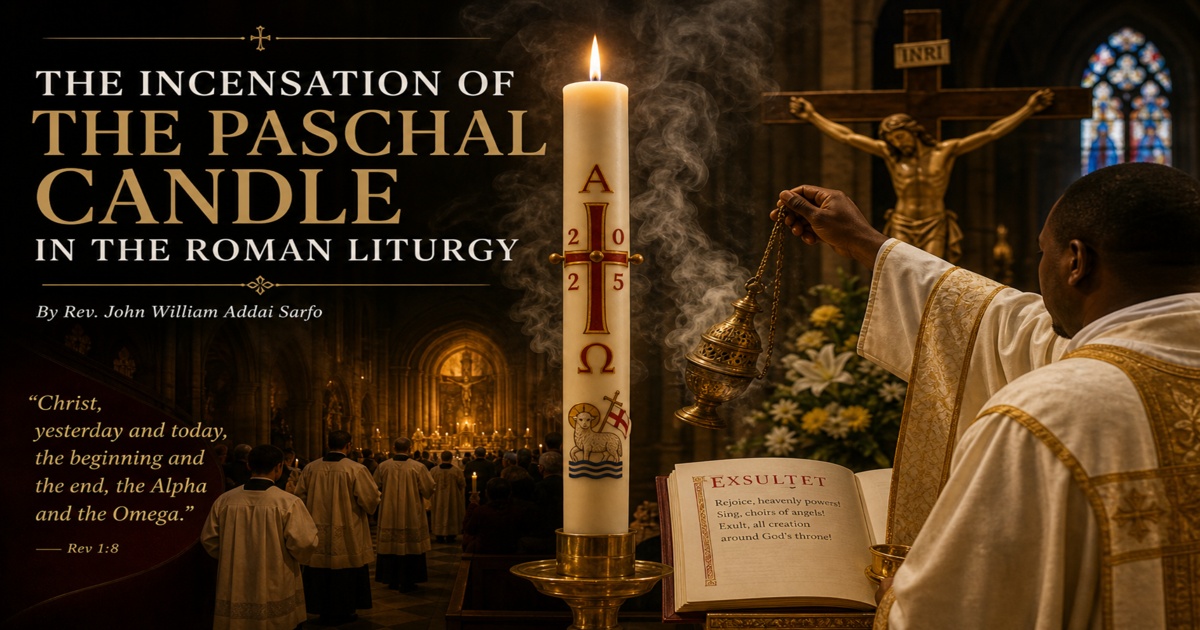
The most significant liturgical moment involving the Paschal Candle occurs during the Easter Vigil, particularly in the proclamation of the Exsultet. The Roman Missal explicitly directs: “The Deacon goes to the ambo… incenses the book and the candle and proclaims the Easter Proclamation (Exsultet).” This instruction is confirmed by the Ceremonial of Bishops, which likewise states that the Deacon incenses both the book and the Paschal Candle during the Exsultet (cf. CB, nos. 352–355). This is the only clearly prescribed moment in the liturgical books where the Paschal Candle is incensed.
Why the Paschal Candle Is Incensed at the Easter Vigil
The Easter Vigil presents a unique liturgical context that calls for particular attention. For instance, the liturgy begins in darkness with the Paschal Candle leading the procession (not the crucifix), while the altar remains stripped and unillumined.
At this moment, the Paschal Candle which symbolically shatters the darkness, becomes the primary visible sign of Christ. This explains why, during the Exsultet the Paschal Candle is incensed while the altar and crucifix are not. This is not accidental, it is theologically intentional. The liturgy is highlighting the Resurrection as the definitive revelation of Christ as Light.
After the Easter Vigil: Divergent Interpretations
Beyond the Easter Vigil, two main interpretations have emerged:
1. Restrictive Interpretation
One school of thought holds that the incensation of the Paschal Candle is strictly limited to the Easter Vigil. This position is based on the fact that no further explicit instructions are given in the Roman Missal or other liturgical books for its incensation during the Easter season. From this perspective, since the liturgical books are silent, the practice should not be extended beyond what is explicitly prescribed.
2. Broader (Permissive) Interpretation
Another view argues that incensation of the Paschal Candle may be permitted during the Easter season, based on more general liturgical principles. This interpretation draws from:
- GIRM 277, which lists objects that may be incensed, including the Paschal Candle.
- Ceremonial of Bishops 88, which allows incense in solemn processions.
- Ceremonial of Bishops 95, which permits the incensation of images and objects exposed for public veneration.
Since the Paschal Candle is the principal symbol of the Risen Christ during Easter, proponents argue that it may reasonably be incensed during solemn celebrations particularly at the entrance procession.
Clarifying the Norms with liturgical books
Outside the Easter Vigil, the structure changes: •
- The crucifix leads the procession again •
- The altar is fully prepared and illuminated •
- The Eucharistic celebration becomes the central focus
Here, the Paschal Candle remains significant, but it is no longer the primary liturgical focal point. This shift explains why the liturgical books do not prescribe its incensation beyond the Easter Virgil. The traditional pattern of incensation returns to the Altar, the Cross, the Gifts, the priest and the congregation.
A careful reading of the liturgical texts suggests the following: The only explicit and obligatory incensation of the Paschal Candle occurs during the Easter Vigil at the Exsultet. Any incensation beyond this is not prescribed and therefore cannot be considered normative.
Moreover, the Norm of General Instruction of the Roman Missal 277 distinguishes: •
- Images of the Lord → incensed with two swings •
- Relics/images of saints → incensed with two swings
“Extremely” deducing from GIRM 227 and CB 95, Proponents of the “broader perspective” raise a decisive question: “Can the Paschal Candle not be acknowledged as an image of the Lord or a relic”? here, the answer is a considerable No. The Paschal Candle is not an image of the Lord nor a relic, but a liturgical symbol of Christ. It uniquely represents Christ as the Light who comes to illumine creation, and it is incensed on Easter Vigil not because it is an image or relic, but because of its sacramental significance: Christ the Light.
Besides, the Paschal Candle is also used at Baptisms and Funerals. Yet, the Proponents of the “broader perspective” generally do not favor or anticipate its incensation. Neither do the liturgical books prescribe its incensation in these rites even though its symbolism remains strong. Consequently, neither liturgical norms nor common practice favors the perception of the Paschal Candle as an image or a relic. In fact, even if ambiguity were to appear, the liturgical celebration of the Pontiff which can rightly be described as “authority in motion” clearly disperses doubts by not incensing the Paschal Candle beyond the Easter vigil.
Conclusion
The incensation of the Paschal Candle is a theologically rich but highly specific ritual act, confined to the Easter Vigil where the liturgy uniquely presents Christ as the Light breaking into darkness. To insist on that theological significance, the liturgical books clearly prescribe the incensation of the Paschal Candle only during the Easter Vigil, at the proclamation of the Exsultet. Beyond this moment, no explicit directive is given.This is significant because if the Church intended the Paschal Candle to be incensed after Easter Virgil as a general rule, it would logically appear in the liturgical books or rites as well, or at best, be lived in the Papal liturgies. Its absence confirms that Incensation is not intrinsic to the Paschal Candle itself, but to the Easter Vigil context.

By Rev. John William Addai Sarfo





Leave a Reply