

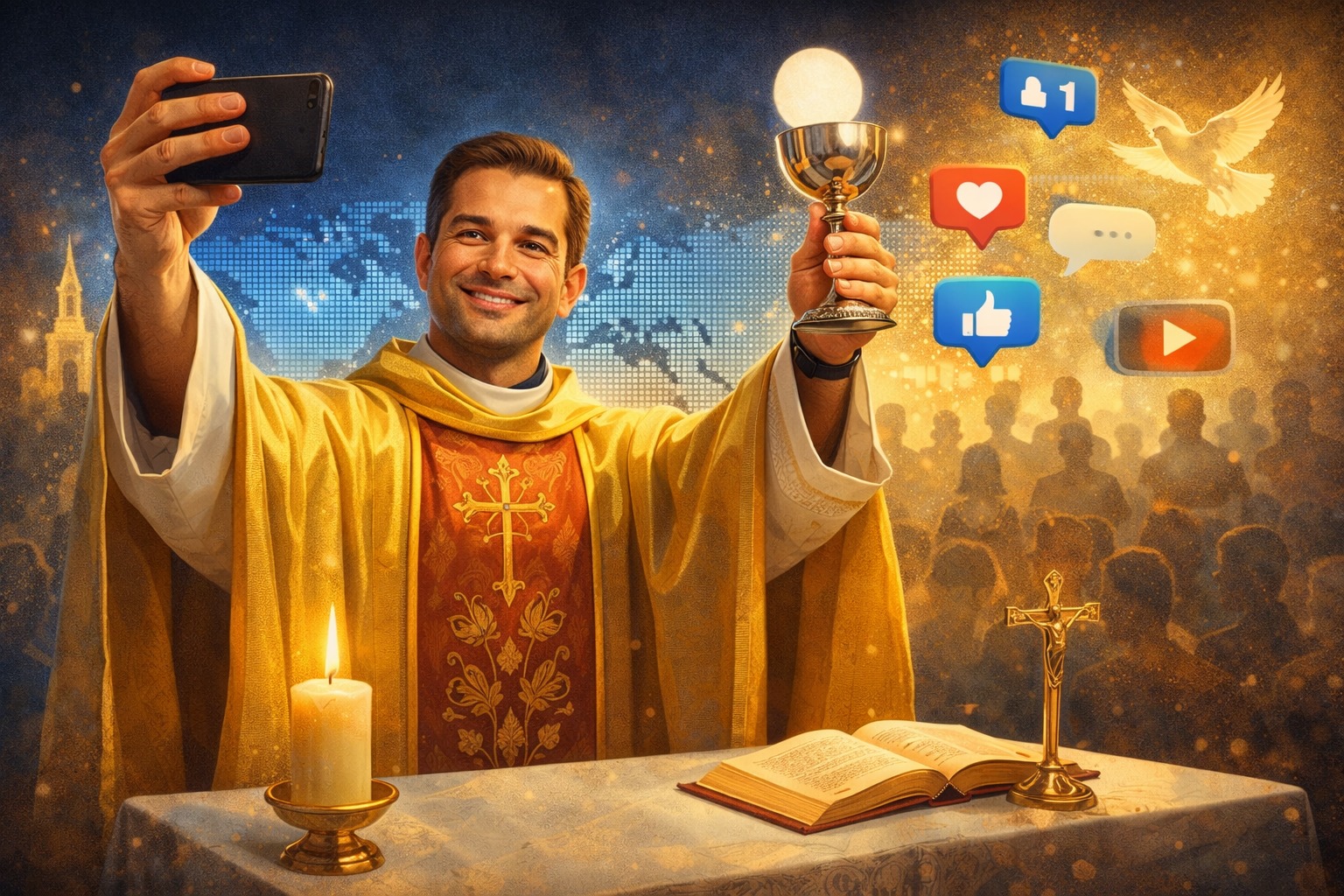
Over a period of six days, I have observed certain developments regarding the engagement of Catholic priests on social media. These observations prompt a deeper reflection on the place of the priest in what may rightly be called a new world—the digital continent. Social media is not merely a tool; it is a distinct space with its own culture, language, rhythms, and inhabitants. In this digital world, every “citizen” defines his or her purpose and mode of presence, a right that the platform itself freely grants.
For the priest, however, presence is never neutral. His engagement in any space—physical or digital—is intrinsically tied to his vocation. The mandate remains unchanged: “Proclaim the word; be persistent whether it is convenient or inconvenient” (cf. 2 Tim 4:2). Social media therefore becomes one of the many places to which the Gospel must be carried. Yet, while the mission is clear, the manner of engagement requires careful discernment.
The digital space offers unprecedented opportunities for evangelization: instant access to large audiences, the ability to reach those who may never enter a church, and the possibility of accompaniment beyond geographical boundaries. At the same time, it carries serious risks. The speed, informality, and emotionally charged nature of social media can easily blur the line between the personal and the pastoral, the prophetic and the provocative, the sacred and the trivial. Without intentional boundaries, the priest’s message can be diluted, misunderstood, or even compromised. I will refer to some unfortunate events over the past few days: a young Italian priest very known on social media who had suspended his priestly ministry for personal reasons; a priest from Nigeria who reduced the scaredness of the title PADRE being used for priests; then, just last night I read of another who held some un orthodox teachings on Sacramental confession. These situations can call for concern, but they are inevitable as long as we remain human. We know this world is for humans, so mistakes are bound to happen. How to deal with them is the challenge. Priests can’t abandon this digital world. I personally have met some wonderful people here and our relationships have been fruitful. A lot happens on these apps.
In exercising his duties in the digital world, the priest must therefore construct clear boundaries— not as walls that isolate, but as guideposts that preserve integrity, credibility, and pastoral fruitfulness. I propose three possible ways of building these necessary boundaries.
1. Clarity of Identity and Purpose
First, the priest must be clear about who he is and why he is present on social media. He does not enter the digital space primarily as an influencer, commentator, or entertainer, but as an ordained minister of the Church. This does not mean that personality, creativity, or humour must be absent (in fact I like humour on social media) ; rather, these should serve the mission and not replace it. When identity is unclear, content becomes inconsistent, and the priest risks oscillating between sacred witness and secular performance. A clear sense of purpose helps ensure that every post, comment, or interaction aligns with the Gospel and the Church’s pastoral mission.
2. Disciplined Speech and Emotional Restraint
Second, boundaries must be built around speech and emotional expression. Social media often rewards outrage, sarcasm, and instant reactions. For a priest, however, words carry weight. Careless statements, heated arguments, or public emotional outbursts can scandalize the faithful and weaken moral authority. Silence, at times, can be more pastoral than speech. Discernment before posting—asking whether a message enlightens, heals, or builds up—becomes an essential discipline in digital ministry. Sometimes, I write and read repeatedly or simply delete posts because they may be misconstrued mostly intentionally by some people or just not the right time for that intervention. However, when human nature sometimes takes over, the digital world must understand and forgive. Why? Because priests or pastors often overlook many reactions from people. The Lord’s Prayer says: “forgive us our trespasses as we forgive those who trespass against us”.
3. Respect for the Sacred and the Pastoral Relationship
Third, the priest must safeguard the sacred nature of his ministry and the confidentiality of pastoral relationships. Not every experience, opinion, or encounter belongs online. The temptation to overshare, seek validation, or turn pastoral moments into content must be firmly resisted. The priest’s life is not a performance but a gift entrusted to him for the sanctification of others. Respecting this boundary preserves both the dignity of priestly office and the trust of the faithful.
Conclusion
Social media is indeed a new world, and the Church community cannot afford to ignore it. Priests are called to be present there—not as passive observers, but as intentional witnesses. Yet presence without boundaries is dangerous. When priests engage the digital world with clarity of identity, disciplined speech, and reverence for the sacred, social media can become a powerful space for authentic evangelization rather than a source of confusion or dilution.
The challenge, therefore, is not whether priests should be on social media, but how they should be here-the digital world. Our presence must be faithful to the vocation, rooted in the Gospel, and guided by pastoral wisdom.
Rev. Fr. Dennis Kormla Senyo Etti (SMA)




Leave a Reply