

By Rev. John William Addai-Sarfo
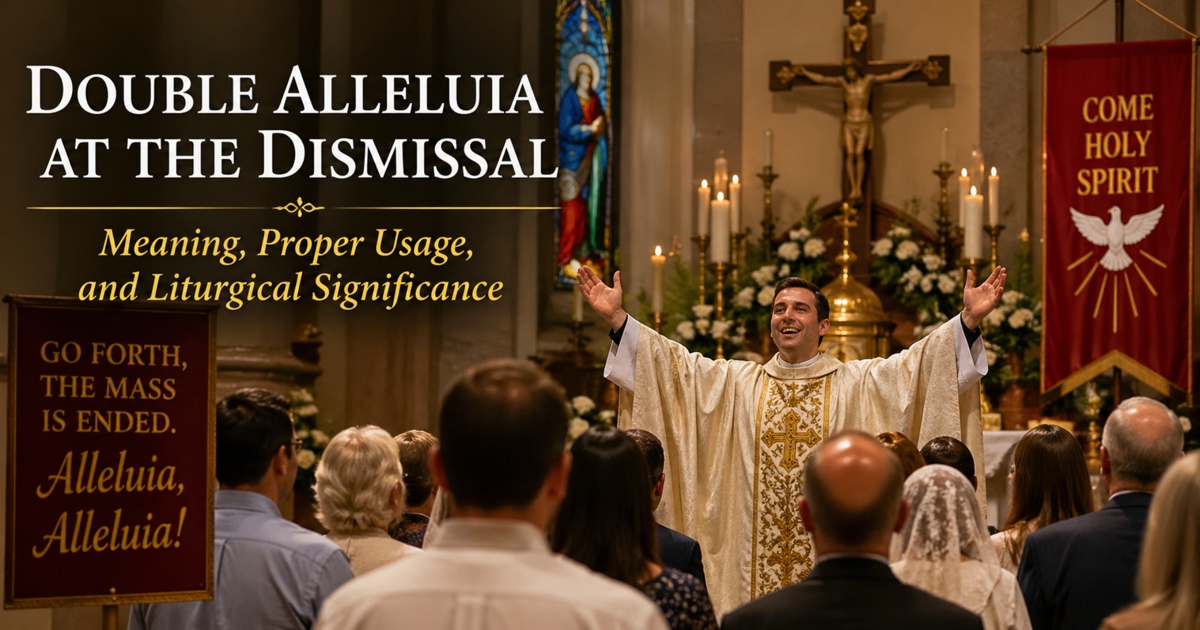
The singing of the Double Alleluia at the dismissal-“Go forth, the Mass is ended, alleluia, alleluia” (or its equivalent) is one of the most striking liturgical expressions of joy in the Roman Rite. Its use is not accidental or decorative; it is deeply rooted in the theology of the Church’s celebration of the Resurrection and the outpouring of the Holy Spirit. Understanding why it is prescribed during the Easter Octave and again at Pentecost helps clarify both its significance and its proper limits.
The Meaning of Alleluia in the Liturgy
The word Alleluia is from the Hebrew words Hallel and Yah, meaning “Praise the Lord”. It is the Church’s quintessential cry of joy. During Lent, it is deliberately suppressed as part of the Church’s penitential discipline. Its return at the Easter Vigil marks a dramatic liturgical “resurrection” of praise, mirroring Christ’s own victory over death. Thus, whenever the Alleluia is intensified-such as by doubling it-it signifies an overflowing joy that surpasses ordinary liturgical expression.
Why Double Alleluia During the Easter Octave
The Easter Octave (Easter Sunday to the Second Sunday of Easter- Divine Mercy Sunday) is treated liturgically as one single prolonged day of solemnity. Each day is celebrated as if it were Easter Sunday itself. This theological principle is rooted in the Church’s understanding of the Resurrection as an event so central that it cannot be contained within a single day.
The double Alleluia at dismissal during this octave expresses:
• The fullness of Resurrection joy: The repetition intensifies the proclamation of victory over sin and death.
• Liturgical solemnity: Just as feasts are marked by heightened signs (incense, chant, vestments), so too the dismissal is elevated.
• Continuity of Easter Day: The repeated Alleluia reinforces that the Church is still living within the “first day of the new creation.”In short, the double Alleluia is not merely ornamental; it is a liturgical proclamation that Christ is truly risen, and the Church cannot contain her joy.
Why It Returns at Pentecost
The second time the double Alleluia appears is at Pentecost Vigil and Pentecost Sunday. This is not a random repetition but a theologically coherent one. Pentecost is often called the “completion of Easter.” What began at the Resurrection reaches its fulfillment in the outpouring of the Holy Spirit. The same Paschal Mystery-Christ’s dying, rising, and glorification-is now extended to the Church.
The double Alleluia at Pentecost signifies:
• The culmination of Paschal joy: The Resurrection finds its fruit in the birth of the Church.
• The joy of the Holy Spirit: The Spirit is the gift of the risen Christ, and His coming is cause for the same exuberant praise.
• A liturgical inclusio: The Church frames the Easter season with heightened joy—at its beginning (Octave) and its climax (Pentecost).
Theses points posit that the double Alleluia at Pentecost is not a repetition of Easter but a completion of it.
Liturgical Norms: When It Should Be Used
According to the Roman Missal and its rubrics: The double Alleluia is prescribed: At the dismissal during the Easter Octave and at the dismissal on Pentecost Sunday and its Vigil. Outside these times, the dismissal returns to its usual form. A liturgical scholar known as Fr. Edward McNamara reflecting on the rubrics and practice of the Church on EWTN states: “The double Alleluia is used at every Mass during the Easter octave and on Pentecost Sunday… On all the other days of Easter season… [it] is not added.”
The GIRM provides the governing rule: “No one… may add, remove, or change anything in the liturgy on his own authority.” (GIRM, no. 24). So, liturgical elements must correspond to “the nature and degree of solemnity of the celebration.”The restraint of the liturgy is just as meaningful as its exuberance. By limiting the double Alleluia: The Church teaches that joy has structure, not randomness, The faithful are led to recognize peaks within the liturgical year and The Paschal Mystery is experienced not as a flat season, but as a journey with a beginning, climax, and fulfillment.
On the Practice of Extending It Beyond the Octave
You may have noted that some priests continue to use the double Alleluia even after the Easter Octave. Liturgically, this is not correct. The Church intentionally limits the double Alleluia to specific high points. Extending it beyond the Octave dilutes its symbolic weight. The liturgy operates with precision: not everything joyful is expressed in the same way at all times. While the entire Easter Season is indeed joyful, the Church distinguishes degrees of celebration. The Octave and Pentecost stand at a higher level, and the double Alleluia is reserved to mark that distinction. So, continuing it beyond the Octave is best described as: A pastoral or personal addition, not supported by the rubrics and a practice that risks blurring liturgical structure and meaning.
Conclusion
The double Alleluia at the dismissal is a carefully placed liturgically. It appears at the Easter Octave, to express the boundless joy of the Resurrection and at Pentecost, to celebrate the fulfillment of that joy in the Holy Spirit. Its limited use is intentional and meaningful. When respected, it allows the Church’s prayer to speak with clarity and depth; when overused, it risks losing the very intensity it was meant to convey.




Leave a Reply