

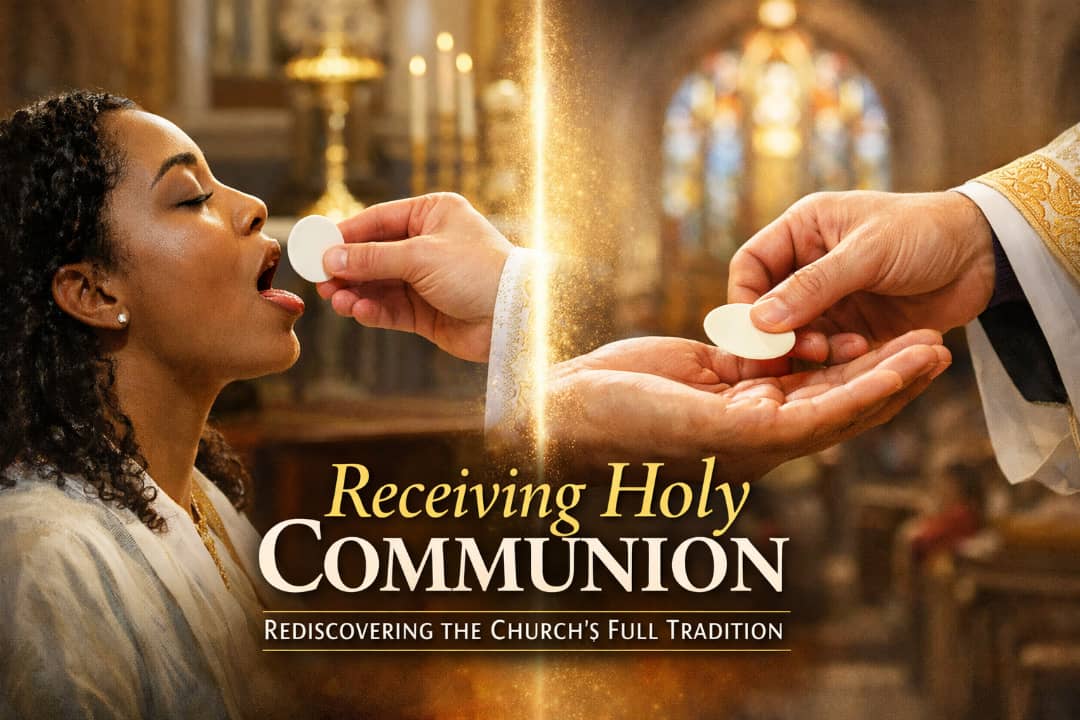
Like many other places around the globe, on Tuesday, June 9, 2020, in the heat of the COVID-19 pandemic, the Ghana Catholic Bishops Conference (GCBC) issued precautionary directives that ‘encouraged’ the faithful to receive Holy Communion in the palm of the hand. As pastoral servants of the God of the twin-pillars of Faith and Reason, our Lord Bishops released those measures as pastoral responses to a global health emergency and were meant to protect the People of God.
Today, the circumstances that necessitated those temporary directives have largely passed. Yet it appears that many of the faithful remain, perhaps unconsciously, shaped by the habits formed during that period, or have come to regard Communion in the palm as the exclusive way to receive the Eucharist. In fact, with the determination of the Conference of Bishops and the recognitio of the Apostolic See, “the faithful should receive Communion kneeling or standing. ‘However, if they receive Communion standing, it is recommended that they give due reverence before the reception of the Sacrament, as set forth in the same norms’… Therefore, it is not licit to deny Holy Communion to any of Christ’s faithful solely on the grounds, for example, that the person wishes to receive the Eucharist kneeling or standing” (Redemptionis Sacramentum, 90-91).
Recognizing the different spiritual sensibilities among the faithful, the Church in her wisdom appreciates that reverence can be expressed in different ways and the fact that unity in faith does not require uniformity in every gesture and posture, instructs, that ‘although each of the faithful always has the right to receive Holy Communion on the tongue, at his choice, if any communicant should wish to receive the Sacrament in the hand, in areas where the Bishops’ Conference with the recognitio of the Apostolic See has given permission, the sacred host is to be administered to him or her’ (GIRM, 161; Redemptionis Sacramentum, 92). This statement establishes two important truths: Receiving on the tongue is the universal norm of the Church, and receiving in the hand is an open indult for some permitted regions.
Related to the two basic ways of reception, the key principle is reverence and faith in the Real Presence of Christ. Historically in the Church however, receiving the Eucharist directly on the tongue gained an ordinary acceptance with the organic understanding of the real presence of Christ in the Eucharist. As I have currently observed, with the vast majority of communicants in large congregations now receiving the Sacrament in the palm of the hand, and only a few, or sometimes none receiving on the tongue, it may be fitting for us as a Church to pause and recall the reverential understanding of the Eucharist that shaped earlier practices. This understanding sought to highlight not only the sacredness of the consecrated Host but also the careful safeguarding of even the smallest Eucharistic fragments, which the Church has always treated with profound reverence.
This practice is dogmatically ingrained in the Church’s life as defined by the Council of Trent, Session XIII, Chapter III (DS 1641): ‘It is most true, that as much is contained under either species as under both; for Christ whole and entire is under the species of bread, and under any part whatsoever of that species; likewise the whole (Christ) is under the species of wine, and under the parts thereof.’ The Catechism of the Catholic Church (1377) appeals to the same authority with much more clarity: ‘The Eucharistic presence of Christ begins at the moment of the consecration and endures as long as the Eucharistic species subsist. Christ is present whole and entire in each of the species and whole and entire in each of their parts, in such a way that the breaking of the bread does not divide Christ.’
In his objection to the claim that ‘it is impossible for the entire Christ to be under every part of the species,’ St. Thomas Aquinas in his Summa Theologiae (Part III, Question 76, Article 3) appeals to the bishop of Hippo (each receives Christ the Lord, Who is entire under every morsel, nor is He less in each portion, but bestows Himself entire under each) to emphasize the same teaching of the Church by stating ‘that Christ’s body is compared with this sacrament not by reason of dimensive quantity, but by reason of its substance.’
Since ‘the Church makes the Eucharist, and the Eucharist makes the Church’ as famously expressed by Henri de Lubac in Catholicism: Christ and the Common Destiny of Man (trans. L. Sheppard, Ignatius Press, San Francisco 1988, 89), considering the basic teachings of the Church which seeks to protect the sanctity of the Eucharist, there is the need for us all to appreciate that the extraordinary circumstances that shaped the bishops’ calls for communion to be received in the hand have largely passed. Indeed, according to the principle of Cessante causa, cessat effectus (cf. CIC Can. 58 §1 and 93), laws made for particular circumstances like COVID-19 lose their force when the motivating cause ceases. With the help of catechists and pastors, the faithful may naturally return to the full range of practices permitted by the Church without another decree from the proper authorities, related to the same matter.
At a time when the external pressures that once justified temporary changes have largely receded, and when imitations of the Church’s sacraments by religious opportunists appear to be increasingly widespread, the faithful may find renewed spiritual benefit in returning to this venerable practice, not as a rejection of legitimate options, but as a conscious embrace of an instructive and eloquent gesture that has formed generations of Catholics in Eucharistic devotion. Probably, this gives an opportunity to both and clergy and laity to reflect more deeply on the signs and gestures through which the Church expresses her faith, especially when experiencing the Lord in the Blessed Sacrament.
Without prejudice to the acceptability of receiving the Eucharist in the palm of the hand, receiving the Sacrament on the tongue has, for centuries, served as a powerful expression of reverence before the mystery of the Real Presence, reminding the faithful that the Eucharist is not ordinary bread but the very Body of Christ entrusted to the Church. By rediscovering this small but meaningful sign of reverence, we allow our bodily posture to proclaim what the Church has always believed: that in the Holy Eucharist we receive not merely a symbol, but Christ Himself.




Leave a Reply