

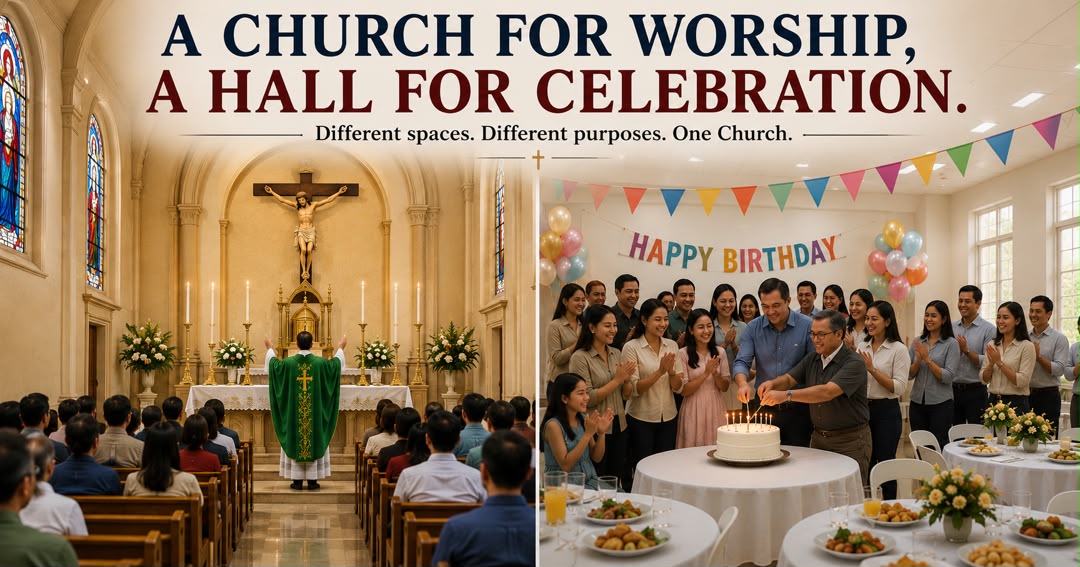
In recent times, a curious trend has emerged in some parishes: birthday cakes, anniversary cakes, graduation cakes, and all manner of celebratory cakes finding their way into the very nave of the church. One begins to wonder whether some parishioners have mistaken the church for a reception venue.
The Catholic Church, in her wisdom, has always distinguished between the church building and the parish hall because each serves a different purpose. The church is a sacred place dedicated to divine worship, while the parish hall exists precisely to accommodate the social, educational, and communal activities of the faithful. The Code of Canon Law teaches that “only those things which serve the exercise or promotion of worship, piety, or religion are permitted in a sacred place” (Can. 1210). The church building is therefore not an extension of a reception ground, a banquet venue, or a party centre. Its primary purpose remains the celebration of the Eucharist, prayer, sacramental worship, and devotion.
The parish hall, however, serves a different function. It is the proper venue for parish meetings, receptions, cultural programmes, educational activities, birthday celebrations, wedding receptions, anniversaries, and other social gatherings. St. Paul reminds Christians, “Do you not have houses to eat and drink in?” (1 Cor 11:22), emphasizing the need to distinguish between acts of worship and ordinary social celebrations. Such activities are good and often necessary for parish life, but they belong in the appropriate place.
This distinction is not merely a matter of convenience but of theology. The Catechism of the Catholic Church teaches that “visible churches are not simply gathering places but signify and make visible the Church living in this place, the dwelling of God with men reconciled and united in Christ” (CCC 1180). The church building signifies the dwelling of God among His people. The parish hall signifies the gathering of God’s people among themselves. The first is ordered primarily to worship; the second is ordered primarily to community life. Imagine a family dining in the bedroom when the dining room is empty and fully available. The issue is not that eating is wrong; it is simply happening in the wrong place.
The General Instruction of the Roman Missal teaches that the sanctuary is the place where the altar stands and where the sacred liturgical ministries are exercised (GIRM 295). It is therefore not intended as a venue for entertainment or social functions. What begins as “just a small cake cutting” can gradually weaken the distinction between the sacred and the secular, a distinction that the Church seeks to preserve through the proper use of sacred places (Can. 1210).
The Church does not oppose celebration. We celebrate birthdays, anniversaries, ordinations, weddings, and milestones because gratitude is a Christian virtue. Yet authentic Christian joy respects sacred space. The existence of parish halls is itself evidence that the Church desires these celebrations to occur but in the proper place.
It is worth noting that the absence of a parish hall does not automatically transform the church building into a reception venue. The sacred character of the church remains unchanged regardless of whether a parish possesses a hall or not (Can. 1210). Therefore, the lack of an alternative venue does not remove the obligation to respect the sacred purpose of the church building. When a parish has no hall, practical alternatives may be sought. Celebrations can be held in any descent and suitable location that preserves the dignity of the occasion without compromising the sacred character of the church.
By Rev. John William Addai-Sarfo





Leave a Reply