

By Benedict Owusu Agyei
INTRODUCTION
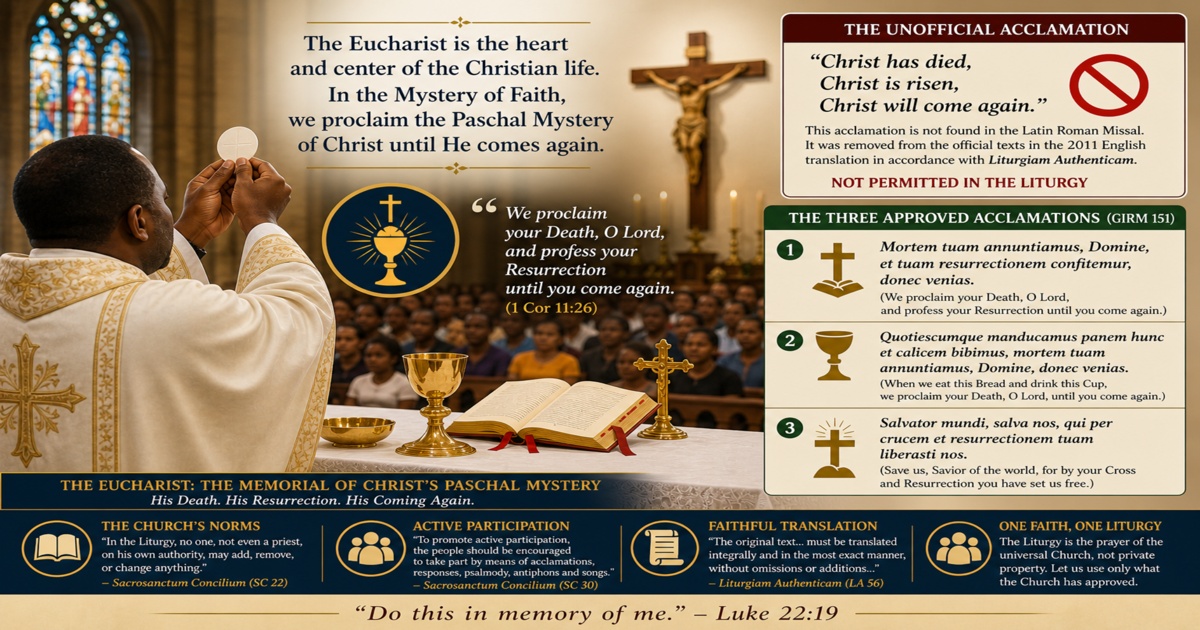
In the Roman Catholic Church, the sacred Liturgy (which is the official act of the Church’s worship) holds an important place in the life of the Church. Within the Sacred Liturgy is the Liturgy of the Eucharist which is the heart and center of the Christian life. In the celebration of the Eucharist (Mass), there is a part known as the “anamnesis” which is the recalling into memory the paschal mystery of Christ, where after prayer of consecration the Priest intones the mystery of faith. To this intonation, the congregants respond by saying one of the three (3) approved acclamations of the mystery of faith found in the Roman Missal (Romanum Missale). For some time now, there has been an advent of an acclamation (Christ has died, Christ is risen, Christ will come again) which has been infused into the Liturgy of the Eucharist so the congregants say this instead of the approved ones. The use of this newly created acclamation is most prevalent among the Twi and English speaking Parishes and Quasi-parishes during the Easter Season. Although it is clear and sound theologically, and conforms to the Character of Easter season, by the general liturgical norms of the church we are not permitted to add, remove or change anything in the liturgy as if it were a private property (Sancrosanctum Concilium, SC 22). The translation of this acclamation, moreover, seems not to conform to the official Latin Liturgical texts. This has led to some questions raised by the laity concerning its appropriate usage in the Mass.
This article seeks to examine the historical background of the mystery of faith acclamations, the origin of this newly created acclamation and its inclusion in the Liturgy; and whether it is/not permitted in the liturgy and instructions on the three approved ones.
HISTORICAL BACKGROUND OF THE MYSTERY OF FAITH ACCLAMATIONS
The Mystery of Faith acclamation (Mysterium Fidei) was developed from the early Church’s tradition of liturgical responses by the faithful during the Eucharist. In the ancient liturgies, the people often answered with words aimed at proclaiming Christ’s death, resurrection, and his coming again. In the Roman Rite before the Second Vatican Council, the phrase Mysterium Fidei was included within the words of consecration of the chalice in the Tridentine Mass. Later, the Second Vatican Council encouraged greater participation of the faithful in the liturgy through “acclamations and responses.” Sacrosanctum Concilium states: “To promote active participation, the people should be encouraged to take part by means of acclamations, responses, psalmody, antiphons and songs” (SC 30).
Following this directive, Pope Paul VI revised the Roman Missal in 1969. The phrase Mysterium Fidei was removed from the formula of consecration and became an invitation by the priest after the consecration, introducing the people’s memorial acclamation. This reform drew attention to the Paschal Mystery of Christ (His death, resurrection, and second coming) as the center of the Eucharist. The current acclamations in the Mass therefore express the faith of the Church in the mystery of salvation made present in the Eucharist.
HOW THE ACCLAMATION “CHRIST HAS DIED, CHRIST IS RISEN, CHRIST WILL COME AGAIN” CAME INTO THE LITURGY AND HOW IT WAS TAKEN OUT OF LITURGICAL TEXTS
The acclamation “Christ has died, Christ is risen, Christ will come again” was introduced in the English translation of the Roman Missal after the liturgical reforms of the Second Vatican Council. It appeared in the 1973 ICEL (International Commission on English in the Liturgy) translation as one of the memorial acclamations used after the priest says, “The mystery of faith.”
However, this acclamation (Christ has died, Christ is risen, Christ will come again) was not found in the official Latin Roman Missal (Missale Romanum). It was an English composition meant to summarize the Paschal Mystery of Christ. Because of its simplicity, it became very popular in many English-speaking countries.
When the new English translation of the Roman Missal was issued in 2011, the Church removed this acclamation from the liturgy. The reason was that the translation aimed to follow the Latin text more faithfully, according to the Vatican instruction Liturgiam Authenticam (2001), which required translations to correspond closely to the official Latin liturgical texts.
The Holy See explained that:
“Christ has died, Christ is risen, Christ will come again” had no direct Latin equivalent in the Roman Missal. The approved memorial acclamations are addressed directly to Christ and express the participation of the faithful in the Paschal Mystery.
IS ITS USAGE PERMITTED OR NOT?
In the current Roman Missal, there are three approved acclamations which liturgical texts have prescribed for use in the liturgy. The General Instruction of the Roman Missal (GIRM) 151 states that, “After Consecration when the Priest has said, The mystery of faith, the people pronounce the acclamation, using one of the prescribed formulae.” So by implication, the people are to pronounce one of the three approved acclamations.
Currently, the acclamation: “Christ has died, Christ is risen, Christ will come again” has been officially removed from the Roman Missal because it had no direct Latin equivalent in the Roman Missal as Liturgicam Authenticam (LA) states, “The translation of the liturgical texts of the Roman Liturgy is not so much a work of creative innovation as it is of rendering the original texts faithfully and accurately into the vernacular language” (LA 20). It further states that, “The original text, insofar as possible, must be translated integrally and in the most exact manner, without omissions or additions…” (LA 56). Now considering that the acclamation “Christ has died, Christ is risen, Christ will come again” translation did not reflect the original texts of the Latin, its usage is not permitted in the Liturgy of the Eucharist.
To this, no one is supposed to continue using the acclamation “Christ has died, Christ is risen, Christ will come again” in the celebration of the Eucharist. The liturgy is not anyone’s property for a few to be adding or changing anything on their own authority (SC 22, para. 3).
THE THREE APPROVED ACCLAMATIONS
The approved Latin acclamations for the Mysterium Fidei in the Roman Missal and the official English translations are:
1. Mortem tuam annuntiamus, Domine, et tuam resurrectionem confitemur, donec venias.
(We proclaim your Death, O Lord, and profess your Resurrection until you come again.)
2. Quotiescumque manducamus panem hunc et calicem bibimus, mortem tuam annuntiamus, Domine, donec venias.
(When we eat this Bread and drink this Cup, we proclaim your Death, O Lord, until you come again.)
3. Salvator mundi, salva nos, qui per crucem et resurrectionem tuam liberasti nos.
(Save us, Savior of the world, for by your Cross and Resurrection you have set us free.)
These texts are found in the official Missale Romanum promulgated by Pope Paul VI and revised under Pope John Paul II and, are what the liturgical texts have approved for use in the Liturgy of the Eucharist. These three acclamations can be used in all seasons of the Church.
One thing worth noting is that the Twi translation has only one of the three approved acclamations and this in some way may have contributed to the use of the current unofficial “Christ has died…”, since humans at some point may yearn for diversity because the first of the approved one is at all times used throughout the season. Hence, in their unsettling quest to bring diversity, the unofficial acclamation is used during the Easter season. The Twi has only the first of the three approved one translated for them; and it goes: Awirade, yebeb) wo wuo no dawuro, na y’ada wo wus)re no adi ak)pem s3 wob3sane aba bio. It would be very helpful if the Liturgical commission considers translating the other two approved acclamations so that parishes and quasi-parishes can use them so that the Christian faithful may abreast with the richness of the other acclamations also; and that it may help clear off the use of “Christ has died, Christ is risen, Christ will come again” which the church has not officially sanctioned.
CONCLUSION
In conclusion, the Mystery of Faith acclamations occupy a vital place in the Eucharistic celebration, expressing the Church’s living faith in the Paschal Mystery of Christ. While the acclamation “Christ has died, Christ is risen, Christ will come again” is theologically sound and was once widely used, its exclusion from the current Roman Missal makes its use in the liturgy no longer permitted. Fidelity to the approved liturgical texts remains essential, as the liturgy is the common prayer of the universal Church and not subject to personal adaptation. Therefore, only the three officially approved acclamations are to be used in the Mass. At the same time, greater pastoral attention such as the proper translation and dissemination of all approved acclamations in local languages particularly the Twi, can help foster both unity and meaningful participation among the faithful in our local regions and even beyond.





Leave a Reply