

Introduction
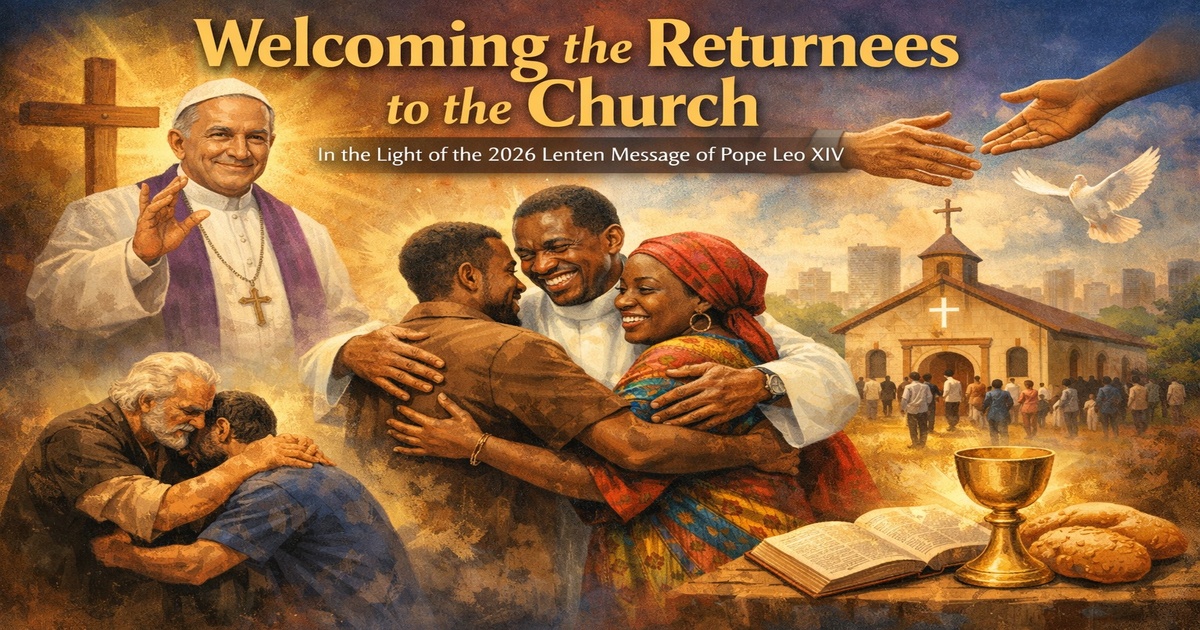
In his 2026 Lenten Message, Pope Leo XIV calls the universal Church to a renewed spirituality of listening, welcoming, fasting, and being kind to our neighbours. These four movements—deeply biblical and pastorally urgent—offer a providential hermeneutical key for addressing one of the pressing concerns of the Church in Africa: the reintegration of baptized Catholics who have lapsed in practice or who have joined other Christian denominations, particularly Pentecostal and Charismatic communities.
Across major African cities such as Lagos, Nairobi, Abidjan, Accra, etc., the ecclesial landscape has been reshaped by vibrant Pentecostal expansion. Many Catholics have departed seeking experiential worship, healing ministries, strong communal belonging, and affective religious expression. Yet a significant number also desire to return after their brush with these denominations. Sometimes I think these brothers and sisters can be welcomed and reintegrated in a better way that will correspond to the Church’s mission of reconciliation.
Lent, traditionally a season of reconciliation and renewal becomes an opportune kairos for articulating a pastoral theology of homecoming rooted in Scripture, Vatican II teaching, and the African ecclesial experience (if possible).
1. Listening: the ecclesial attitude of humble discernment
The first movement proposed by Pope Leo XIV is listening, this is foundational to every good act. Before the Church speaks, she must listen to the Word of God, to the Spirit, and to her children, among which some might be wounded in many ways.
The Parable of the Prodigal Son (cf. Luke 15:11–32) reveals not only a father who runs to embrace, but one who has long listened in hope, scanning the horizon. “While he was still far off, his father saw him and was filled with compassion” (Lk 15:20). Listening here is not passive; it is vigilant love.
The Second Vatican Council’s Dogmatic Constitution Lumen Gentium reminds us that the Church is “at the same time holy and always in need of purification” (LG 8). Listening to returnees requires ecclesial humility. Why did they leave? What spiritual hunger did they experience? What wounds did they carry back to the Church? What can we learn from their experiences?
Moreover, Unitatis Redintegratio teaches that elements of sanctification and truth exist outside the visible boundaries of the Catholic Church (UR 3), though the Catholic Church remains the true and only Church with the depositum fidei (deposit of faith) of faith for our salvation. Many who joined Pentecostal communities encountered genuine scriptural engagement, fervent prayer, and renewed moral commitment. Listening allows the Church to discern these graces as movements of the Spirit that ultimately lead back to Christ and, by right, to the fullness of His Church (the Catholic Church).
In the African context where communal dialogue and consultation of the elderly are intrinsic to reconciliation, listening is not weakness but wisdom. A listening Church mirrors Christ, who asked, “What do you want me to do for you?” (Mk 10:51).
2. Welcoming: the ministry of reconciliation
The second Lenten imperative—welcoming flows directly from the Church’s identity as sacrament of salvation (cf. LG 1). St. Paul affirms: “God… has given us the ministry of reconciliation” (2 Cor 5:18). The Church does not merely tolerate returnees; she receives them as members of Christ’s Body (1 Cor 12:27). The Catechism of the Catholic Church teaches that Baptism imprints an indelible character or mark (cf. CCC 1272). A baptized Catholic who has lapsed or affiliated with another denomination remains ontologically configured to Christ. Thus, return is not a new baptism but a reconciliation, homecoming that ought to be welcomed with gratitude.
Welcoming, however, must be visible and communal. African ecclesiology, shaped by extended family structures and the concept of shared belonging, underscores that reintegration is not purely private. The return of one member is the healing of the body: “If one member suffers, all suffer together” (1 Cor 12:26). The rite of reconciliation in my Ewe culture intrinsically involves sharing of a communal meal to signify the public resolution of all feuds. This is where the Eucharist will play an important role in the welcoming process. The Eucharist remains the “source and summit” of ecclesial life (LG 11), and reintegration ultimately culminates in renewed participation at the Lord’s Table.
In the spirit of the Lenten message, parishes might embody welcome through:
- Public intercessions for reconciliation during Lent.
- Designated days for communal penitential services.
- Catechetical sessions specifically designed for returning Catholics.
- Small Christian Communities that accompany returnees personally.
Welcoming must be warm without being doctrinally ambiguous. Truth and charity remain inseparable (cf. Eph 4:15).
3. Fasting: Ecclesial Self-Examination and Purification
The third Lenten pillar—fasting must not be reduced to dietary discipline. In Isaiah 58, authentic fasting includes loosening the bonds of injustice and restoring right relationships. For the Church in Africa, fasting may involve ecclesial self-examination. Have parish communities been sufficiently hospitable? Has catechesis adequately addressed contemporary spiritual questions? Have liturgies been reverent yet pastorally engaging? In Evangelii Gaudium, Pope Francis describes the Church as a “field hospital” (EG 47), prioritizing healing over bureaucratic rigidity. To fast in this pastoral sense may mean renouncing triumphalism, clerical indifference, or purely juridical approaches to those who left and are willing to come back.
Many African Pentecostal communities offer inculturated or indigenous music and expressive worship; put emphasis on healing and deliverance; allow greater lay participation in both worship and leadership and provide avenues for testimonies of transformation.
Rather than dismissing these realities, Catholic pastoral practice may discern in them a call to deeper inculturation and renewal. The Catholic Charismatic Renewal (CCR) is very vibrant in many parishes. I believe when CCR is properly integrated under episcopal guidance it can offer experiential spirituality within sacramental integrity (respect of the sacraments).
Fasting, therefore, becomes purification of attitude: relinquishing defensiveness and cultivating pastoral charity.
4. Kindness to our neighbours: beyond polemics
The fourth theme—being kind to our neighbours has ecumenical implications. In regions where Catholics and Pentecostals often belong to the same families, harsh polemics fracture social harmony and undermine Christian witness.
Kindness does not imply relativism. Rather, it reflects Christ’s commandment: “By this everyone will know that you are my disciples, if you have love for one another” (Jn 13:35). Returning Catholics should never be shamed for their departure. Instead, their journey may be acknowledged as part of a providential pilgrimage. Hebrews 12:1–2 invites believers to persevere in the race set before them. Sometimes the path includes detours that deepen conviction.
Kindness also extends to clergy and lay leaders of other communities. African societies prize relational peace; therefore, pastoral strategies of reintegration must avoid inflammatory rhetoric. They should not be judged or mocked for slipping outside. Expressions like ‘I told you so’ or ‘why are you back’, should be kept out of the conversation. They just travelled out and are coming back home.
5. Avoiding two Lenten distortions
In expressing the Lenten message, two pastoral distortions must be part of the approach:
- Legalism without mercy: reducing return to canonical procedures without spiritual accompaniment. Every application of laws in the Church must have the final objective of leading the member to salvation.
- Hospitality without truth: minimizing doctrinal divergence for the sake of superficial harmony. We cannot water down the tenets of the faith to accommodate our returnees- veritas et caritas (truth goes with love).
6. The Church as Oikos: a Lenten homecoming
The Greek term oikos (οἶκος), meaning “household” or “home,” resonates deeply with African sensibilities of belonging. The Church is not merely an institution but a spiritual household.
During Lent 2026, inspired by Pope Leo XIV’s call to listen, welcome, fast, and show kindness, African Catholic communities are invited to become visibly recognizable as home. The father in Luke 15 does not interrogate before embracing; he restores dignity through robe, ring, and feast. So too must the Church in Africa manifest sacramental depth, doctrinal clarity, and communal warmth. The return of a baptized Catholic is not a statistical gain but a Eucharistic joy—a sign that grace remains operative.
Conclusion
The reintegration of lost Catholics and those returning from Pentecostal or Charismatic communities is a privileged expression of Lenten spirituality. Listening cultivates humility. Welcoming embodies reconciliation. Fasting purifies ecclesial attitudes. Kindness restores communion.
Grounded in Scripture, illuminated by the teaching of Vatican II, and attentive to the African ecclesial landscape, the Church is called during Lent 2026 to mirror the merciful Father. In doing so, she manifests her perennial identity as Mater Ecclesia thus, ever ancient, ever new, and always ready to receive her returning children.
By Rev. Fr. Dennis Senyo Etti, SMA



Leave a Reply