


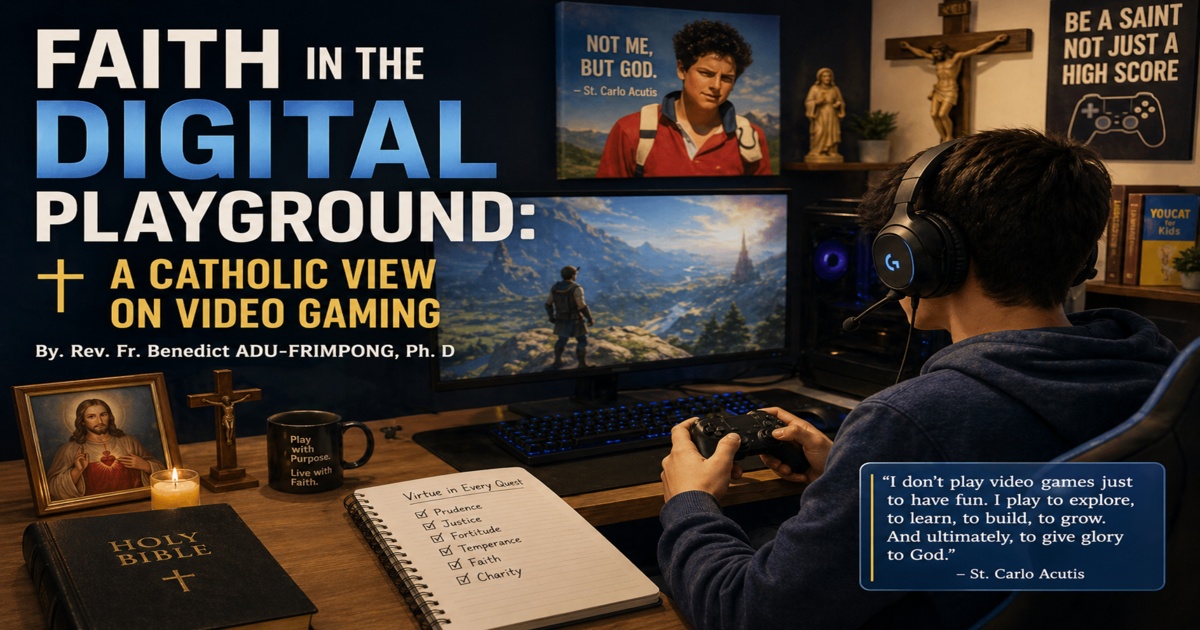
By. Rev. Fr. Benedict ADU-FRIMPONG, Ph. D
Introduction
Without a doubt, video games have become a major formative influence on modern-day culture, particularly among the youth. Needless to say, all indications are that video games shall remain a significant feature of our modern cultural fabric for generations to come. For this reason, when engaging today’s youth, it can be advantageous to have an awareness of the video gaming culture. Indeed, as Catholics “we are called to evangelize the world by entering into dialogue with modern culture.” Hence, it is vital to understand the culture one hopes to evangelize, to speak its language and to recognize its “human quest for meaning.” Otherwise, we risk that the Good News — “that Jesus is the Messiah, the Son of God, and that through believing you may have life in his name” (John 20:31) — may fall on proverbial deaf ears, even among the baptized. This is particularly important for parents who, as the Catechism reminds, have “the responsibility and privilege of evangelizing their children.” (CCC 2225)
Similarly, certain teachers and youth ministers may be concerned or curious about the implications of video games on the formation of young minds. In any case, it is important to have a reasonable grasp of Catholic moral principles and their application to video gaming. This article seeks to address this by, first, exploring the value of legitimate leisure activities, and second, examining the morality of video gaming.
The Value of Leisure
St. Thomas Aquinas underscores the value of relaxation and sensible leisure activities. He explains that, just like the body requires rest and refreshment due to its limited physical stamina, the soul and mind also need respite and recreation because of our finite intellectual stamina. This human need for rest and leisure is highlighted throughout Scripture, not least by its emphasis on the Sabbath, a day of “solemn rest, holy to the Lord” (Exod 31:15) that recalls God’s rest after the work of creation (Gen 2:3). Accordingly, “wise and virtuous” individuals will, from time to time, avail themselves of activities that relax the mind, namely by “playful words or deeds.” To be sure, not all leisure activities are equally good or profitable. For this reason, Aquinas rightly cautions against engaging in pastimes that are harmful, indecent, or outright obscene, yet proposes that certain playful deeds, such as games, can be wholesome.
That said, this ought not to be understood as a license to spend inordinate amounts of time in recreational activities. Pastimes should remain just that — an opportunity to pass time and unwind. Thus, leisure activities need to be carefully balanced with one’s familial responsibilities, occupational obligations, and other commitments. Indeed, Aquinas proposes that excessive play can be sinful, akin to gluttony.
In sum, leisure activities, including games, can be salubrious when enjoyed within reason. Therefore, although being careful to avoid excesses, “everyone should still take care to set aside sufficient time for leisure.” (CCC 2187) So what does this mean concerning video games specifically? Put simply, is it moral to play video games?
The Morality of Playing Video Games
Debate on the morality of playing video is nothing new. Within Catholic circles, it is not uncommon for video gaming to be described as a baneful waste of time and a nidus for vice. One Catholic commentator, for instance, suggests that video games are a “dangerous” form of amusement. Another, while urging judiciousness in game selection, highlights the potential benefits of playing video gaming. To be sure, there is a wide variety of video games, some of which ought to be completely avoided due to their graphically violent, excessively gory, or explicitly sexual content. However, just like the existence of pornographic movies does not mean that the generic act of movie watching is immoral, the existence of morally objectionable video games does not mean that the act of video gaming is inherently evil.
The Catechism teaches that the morality of human actions is determined by three “sources” or considerations: the object, the intention, and the circumstances. (CCC 1750) The object refers to what the act objectively is. It is the “matter of a human act,” what the will has deliberately chosen. (CCC 1751) In the case of video gaming, this would be the very act of playing a video game, including the concrete actions that this entails, e.g., selecting a particular game to play and using a controller to execute in-game tasks. Given that “the object of the choice can by itself vitiate an act in its entirety,” (CCC 1755) it is paramount that the pursued object be morally good.
Hence, it is crucial to examine the object of one’s video gaming. For instance, does the video game encourage creative problem-solving, or is it just a cheap excuse to glorify violence? If the latter, then a case can be made that it is wrongful to play such gratuitously bloodthirsty games. Yet, the mere presence of violence in a video game does not make it evil. It is also worth considering the involvement of the will and player agency during gameplay. Notably, questions have been raised concerning the extent to which in-game moral decisions (e.g., opting to use deception versus being honest) translate into real-world behaviors. Thus, one should ensure that the object of the game “does not rejoice in wrongdoing, but rejoices in the truth.” (1 Cor 13:6)
Regarding the intention and circumstances, both these factors affect the moral gravity of human actions, yet “cannot change the moral quality of acts themselves.” (CCC 1754) The intention refers to the end or “purpose pursued in the action.” (CCC 1752) In terms of video gaming, good intentions may include experiencing inspiring new worlds or strengthening cooperative teamwork among friends. By contrast, bad intentions could include wanting to perform actions that would be otherwise prohibited in real life or to vaingloriously boast about one’s gaming skills.
On the other hand, the circumstance denotes the context in which the action was performed, such as the environment, predicament, or social pressure. (CCC 1756) The circumstances “contribute to increasing or diminishing the moral goodness or evil of human acts [. . .] They can also diminish or increase the agent’s responsibility.” (CCC 1754) With regards to video gaming, the negative circumstances may include peer pressure to play a particularly violent game or certain addictive behaviours, whereas positive circumstances may comprise enjoying a wholesome game with one’s children, playing a video game in order to write a review, or — if lucky enough — gaming as part of a professional esports team.
As the Catechism explains, “a morally good act requires the goodness of the object, of the end, and of the circumstances together.” (CCC 1755) Put simply, in the context of video gaming, one must: (1) play suitable, good games, (2) for a wholesome reason, and (3) in a rightful manner. Furthermore, it is worth noting the potential risk for scandal — “an attitude or behavior which leads another to do evil” (CCC 2284) — while gaming. For instance, one should avoid immoderate gaming because this might lead others to believe that excessive gaming is “okay.”
Conclusion
St. John Paul II reminds us that “the very evangelization of modern culture depends to a great extent on the influence of the media.” Therefore, it is “necessary to integrate [the Christian] message into the ‘new culture’ created by modern communications.” In today’s world, this includes the ever-growing video gaming culture.
While not all video games are worth playing, on the whole, gaming can be considered a legitimate leisure activity. This underscores the need for proper moral conduct whilst gaming. Indeed, video games should not be taken as petty entertainment but as engaging opportunities to stimulate edifying curiosity about the world and cultivate virtue.
In practical terms, this means carefully selecting what games one — or, if a parent, one’s children — plays. Akin to movies, video games also attract a content rating, and this is a handy way to check age suitability. However, ratings, while useful, do not provide a full picture. For this reason, it is advisable to consult game reviews before playing, particularly from Catholic reviewers. Furthermore, one should always play with decency, thus avoiding unfair or cruel gameplay. Accordingly, parents are encouraged to experience gaming together with their children to promote good behavior and healthy relationships. Last but not least, video gaming ought to never take precedence over real-life activities, such as in-person time with family or friends and, of course, time with God through an active prayer life.
As Catholic Christians, we are called to evangelize the culture and help the world see what is good, true, and beautiful, including with respect to video games. Saint Carlo Acutis, patron of youth and computer programmers, de facto patron of video gaming, pray for us!






Leave a Reply