


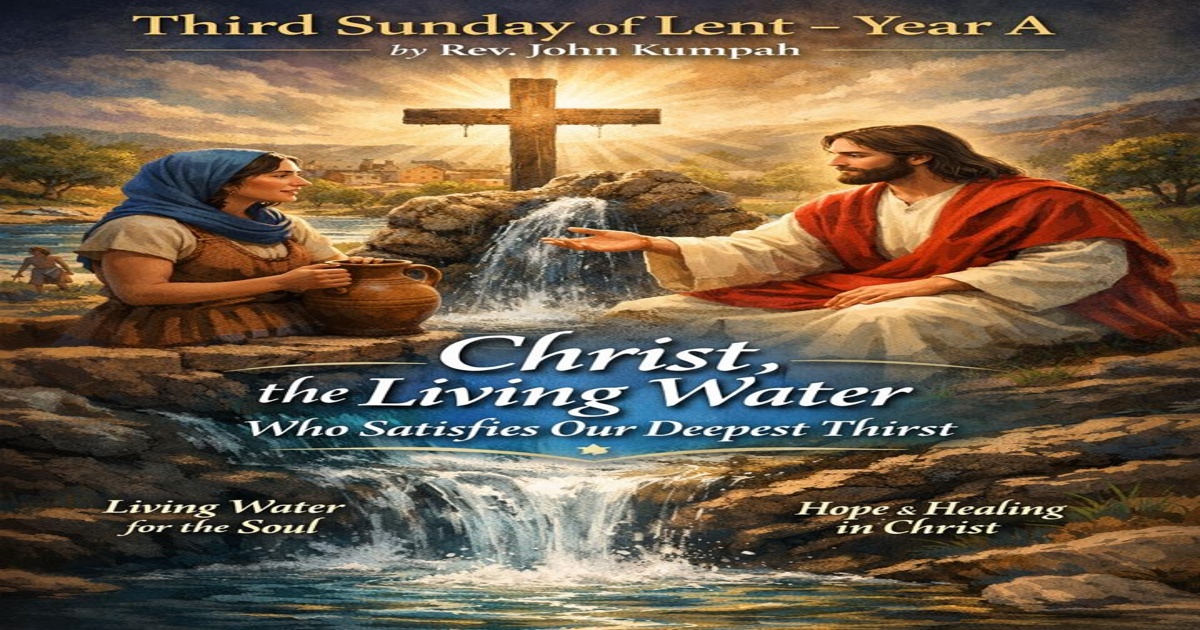
“Christ, the Living Water Who Satisfies Our Deepest Thirst”
By Rev. John Kumpah
My dear brothers and sisters, many of our towns and villages bear the names of rivers. Few to be mention are Tanoso, Biaso, Offinso, Goaso and the rest. Our ancestors named these towns and villages after these rivers because the settled around these rivers. They settled around the rivers for easy access for water for their daily activities. Water is one of the most important realities in human life. Without water, life collapses. Crops fail, bodies weaken, and communities suffer. In our Ghanaian experience, we know that where water is scarce, there is sickness, struggle, and even conflict. But where water flows, there is life, health, and hope. Today’s readings revolve around this simple but powerful truth: water is necessary for life but God uses water to reveal something even deeper about us.
In the first reading, we hear, “Give us water to drink” The Israelites are in the wilderness, a place of testing and purification. Their thirst for water is real, but deeper than physical thirst is a crisis of faith. They complain against Moses and ultimately question God: “Is the Lord among us or not?” (Ex 17:7) This is not mere murmuring; it is a spiritual struggle. Yet God responds not with punishment, but with mercy. Water flows from the rock at Horeb. Saint Paul later tells us that “the rock was Christ” (1 Cor 10:4). Already in the Old Testament, God reveals Himself as the One who sustains His people even when their faith is weak. God’s grace precedes human merit. Even in rebellion, God remains faithful. This prepares us for Christ, whose mercy flows abundantly from the Cross.
In the Gospel, Jesus meets the Samaritan woman at Jacob’s well. In this meeting, there are four significant things which happened which I will like consider.
Jesus breaks barriers: Jesus speaks with a Samaritan, a woman, and a sinner. Three barriers in one encounter. This reveals the universality of salvation. Grace is not limited by ethnicity, gender, or past sins.
Moving from physical thirst to spiritual thirst: The woman comes to draw water, but Jesus draws out her heart: “Whoever drinks the water I shall give will never thirst” (Jn 4:14). Her five husbands represent not only moral brokenness but the emptiness of a life seeking fulfillment outside God. Jesus does not condemn her; He reveals her truth in order to heal her.
True worship: Jesus proclaims a new worship, “In spirit and in truth” (Jn 4:23) This anticipates the sacramental life of the Church, where worship is no longer bound to a place but is centered on Christ, truly present in the Eucharist.
From sinner to missionary: The woman becomes an evangelist. She leaves her water jar, symbol of old desires and runs to the town. Conversion leads naturally to mission.
Three lessons for us in today’s text:
Our society is thirsty but for what? In Ghana today, many thirst for: Money at all costs, Power and political influence, Quick miracles and prophetic shortcuts, social media validation. Yet, like the Samaritan woman, these wells do not satisfy. Jesus reminds us that material progress without spiritual depth leads to inner dryness.
The temptation to “test God” Like the Israelites, we often ask: “Where is God in this economic hardship?”, “Where is God in corruption and unemployment?”, “Where is God when prayers delay?” Lent calls us to trust rather than test God, to deepen faith rather than complain.
Moral conversion before true worship: Many claims to worship God yet live double lives. Jesus teaches that true worship must be rooted in truth. In our Ghanaian Catholic communities, this challenges: Sacramental participation without moral integrity, Church leadership without personal holiness, public religiosity without justice and charity. As Saint Augustine says: “You have made us for Yourself, O Lord, and our hearts are restless until they rest in You.” God needs our true hearts in worship.
I then conclude dear brothers and sisters in Christ that this Lent, Christ sits at the well of our lives and says: “Give me a drink.” He thirsts for our faith, our repentance, our hearts. And in return, He offers us living water, grace that forgives, heals, and transforms. May we leave behind our empty jars, return to Christ, and become witnesses that Jesus alone satisfies the deepest thirst of the human heart.
May God bless us.



Leave a Reply