

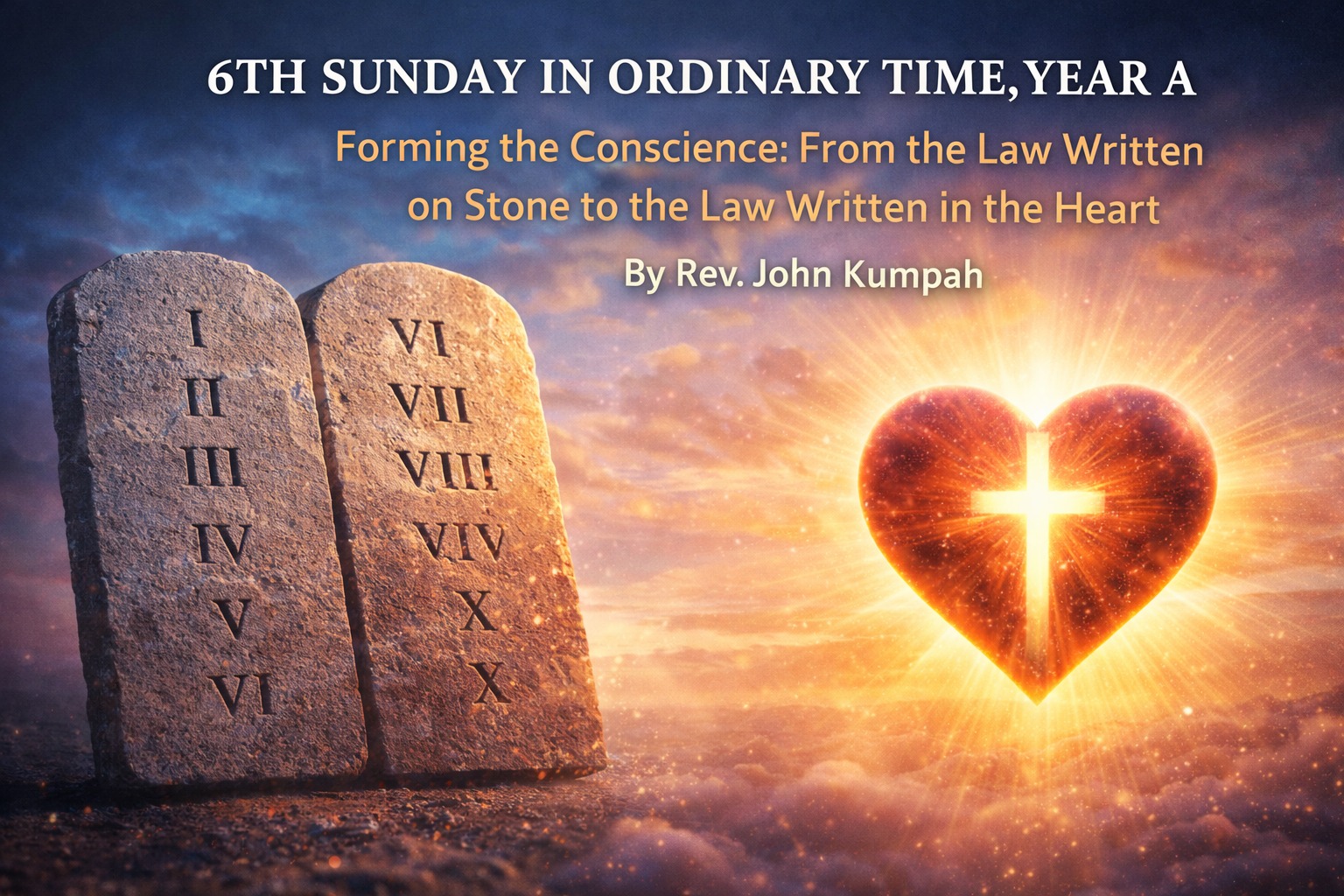
Forming the Conscience: From the Law Written on Stone to the Law Written in the Heart.
By Rev. John Kumpah
My dear brothers, among the Akans, the etymology of the word (Nnipa) Human being comes from the words (Ↄnim papa) which means he/she knows what is good. And sometimes we hear of a saying that “Onipa yɛ onipa.” A human being must act like a human being. To be “onipa” is not simply to be born. It is to live responsibly. When someone behaves badly, people say, “Wonnyɛ onipa” you are not acting like a human being. In other words, true humanity is shown in moral conduct. Today’s readings speak directly to this Akan understanding of the human person. They teach us that God created us as moral agents, capable of choosing good or evil and therefore responsible for our choices. In this world, this truth touches the very heart of our being: the formation of conscience.
In the first reading from Sirach, we hear these powerful words: “Before man are life and death, good and evil; whichever he chooses shall be given him.” Scripture is very clear to us today that God has given us freedom. He does not force us to sin. He does not command anyone to do wrong. He sets before us life and death and allows us to choose.
The inner ability to choose rightly is guided by conscience. Conscience is that quiet inner voice that tells you, “This is right,” or “This is wrong.” But conscience does not automatically become strong. It must be formed. If we ignore it repeatedly, it becomes weak. If we train it through prayer, discipline, and truthfulness, it becomes sharp and reliable.
In the Gospel, Jesus takes the commandments even deeper. He says it is not enough not to kill; you must not harbor anger. It is not enough to avoid adultery; you must not entertain lust in your heart. It is not enough to avoid false oaths; your simple “Yes” must mean “Yes.”
Jesus moves morality from the outside to the inside. He teaches us that sin begins in the heart. One may appear disciplined externally by attending prayers, wearing the cassock properly and nicely, speaking respectfully and yet inside there may be jealousy, hatred, pride, impurity, or dishonesty. Christ is not satisfied with outward conformity. He demands interior transformation.
This is exactly where formation of conscience becomes essential. Our life as human beings is not only about being successful or external discipline. It is about shaping the heart. A well-formed conscience asks not, “Will the people see or be looking at me?” but “Is this pleasing to God?” It does not act out of fear of punishment but out of love for what is good and true.
In our world of moral decay, community life exams our conscience daily. Small misunderstandings arise, corrections are given, and sometimes opinions differ. Without a good formed conscience, anger grows silently. Jesus warns that anger itself is danger. A human being who cannot control anger among their peers and loved ones will struggle even more in the outside world.
Purity of heart is another serious area. In our time, temptations are everywhere especially through social media and mobile phones. Jesus speaks strongly about lust because He knows that what we repeatedly entertain in the heart eventually shapes our character. If the conscience is not trained to reject impure thoughts now, ordination will not magically change us as our former Rector use to tell us. The discipline we build today protects our priesthood tomorrow.
Truthfulness is equally important. “Let your Yes mean Yes,” Jesus says. In seminary life, integrity must mark everything in our day-to-day activities like academic work, spiritual direction, relationships, pastoral reports. A priest without integrity can wound the Church deeply. But a priest with a clear conscience becomes a source of trust and healing. The Akan say, “wͻsuban na εkyerε nnipa a wͻyε” a person reveals him/herself by his/her actions. Every small choice you make is shaping the kind of priest you are becoming. Choosing silence instead of gossip, choosing study or work instead of laziness, choosing humility instead of pride, choosing prayer instead of distraction. These small daily decisions form your conscience.
Sirach tells us again today: life and death are before us. In the seminary, that choice appears in simple forms that is discipline or carelessness, obedience or rebellion, purity or compromise, truth or deception. You cannot blame anyone else. You are responsible. That is what it means to be truly ‘onipa’, a moral agent before God.
My dear brothers, the Church does not only need intelligent priests. She needs men with clear consciences, clean hearts, and strong moral character. Formation is not merely completing philosophy and theology. It is allowing Christ to purify your heart so that your interior life matches your external vocation.
May we choose life daily. May we allow God’s word to sharpen our conscience. May we truly become “onipa pa” good and responsible human beings ready to shepherd God’s people with integrity and holiness. May God bless us.
Amen.


Leave a Reply