

To the introductory part of this article, Kindly follow this link: Shortage of Communion at Mass: What to Do and What Not to Do?
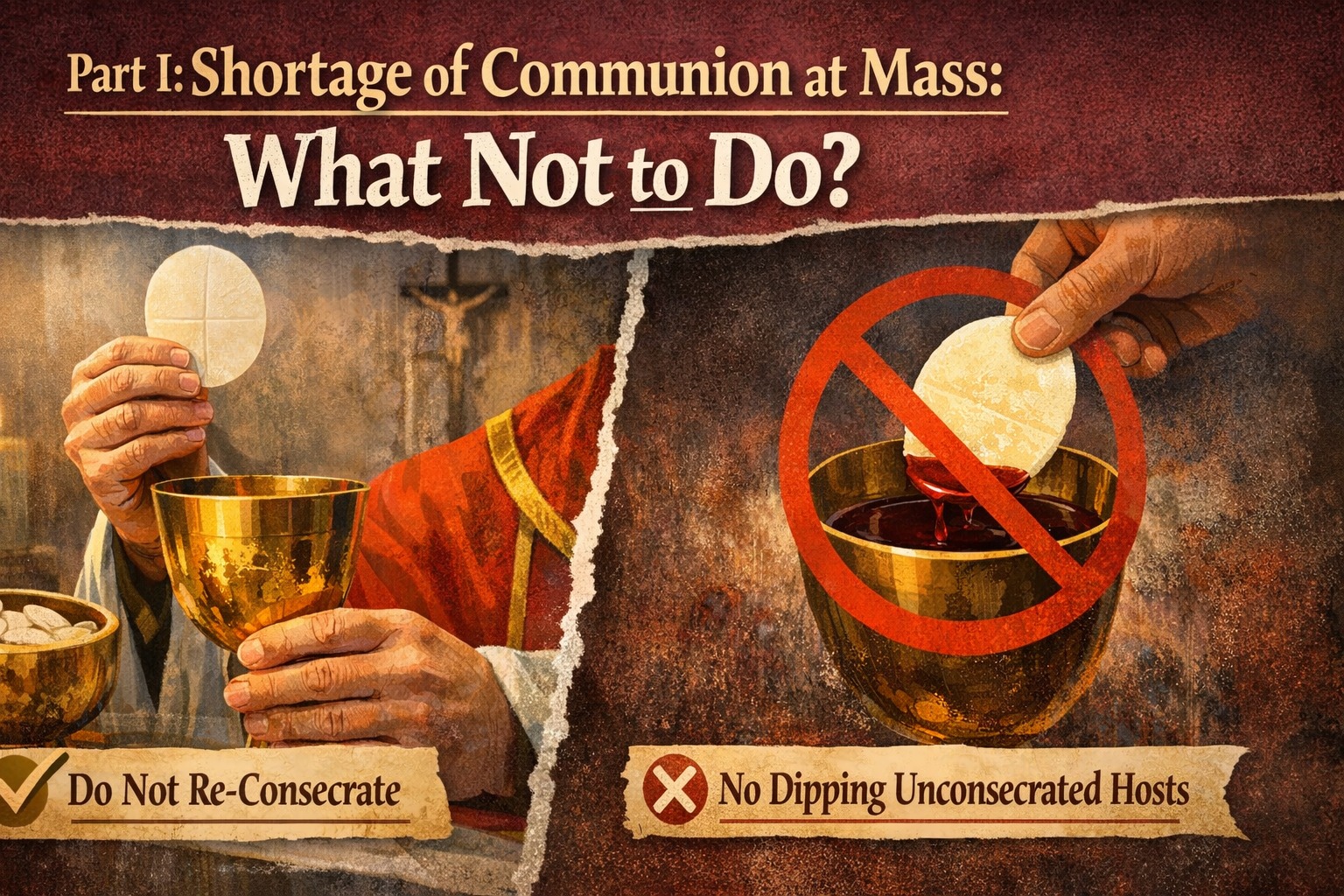
Shortage of Communion at Mass: What Not to Do?
The Eucharistic sacrifice is therefore singular in nature, sacramentally re-presented through one Eucharistic Prayer, not through multiple consecratory acts. For this reason, ‘the reprobated practice by which Priests, Deacons or the faithful here and there alter or vary at will the texts of the Sacred Liturgy that they are charged to pronounce, must cease. For in doing thus, they render the celebration of the Sacred Liturgy unstable, and not infrequently distort the authentic meaning of the Liturgy’ (RS, 59).
As St. Alphonsus Liguori (Theologia Moralis, Caput I:VI) explains, ‘the form is the words pronounced by the minister. But for the sacrament to be valid, a connection, or simultaneity of matter and form, is required, namely, that the matter be applied before the utterance of the form is terminated, or after the utterance of the form has begun. But the opinion that it is sufficient to apply the matter immediately before or after the utterance of the form is only probable, but not morally certain, as is required, where the validity of the sacrament is concerned.’1 This moral certainty is essential whenever the validity of a sacrament is at stake.
Apart from the fundamental principle that ‘the ordering and guidance of the sacred liturgy depends solely upon the authority of the Church, namely, that of the Apostolic See and, as provided by law, that of the diocesan Bishop’ (CIC Can. 838 §1; CCEO, canon 707), the CIC Canon 927 unequivocally states that ‘it is absolutely forbidden, even in extreme urgent necessity, to consecrate one matter without the other or both outside the eucharistic celebration.’ While this canon primarily addresses consecration outside Mass, its underlying principle safeguards the integrity of the Eucharistic Prayer itself, ensuring that consecration occurs within the one, proper, and complete sacramental action, not as an improvised appendage. Accordingly, a ‘second consecration’ after the Eucharistic Prayer has concluded is, in effect, a de facto repetition of the consecratory act outside the rite, even if it happens prior to Communion. In the Latin Church like the Byzantine tradition, consecration occurs once, during the Anaphora which is ‘one single, indivisible act of offering’ (CCEO can., 698).
The prohibition against consecrating additional matter due to a shortage does not contradict De Defectibus (V:2) or GIRM 324 (If the priest notices after the consecration or as he receives Communion that not wine but only water was poured into the chalice, he pours the water into some container, then pours wine with water into the chalice and consecrates it. He says only the part of the institution narrative related to the consecration of the chalice, without being obliged to consecrate the bread again) when these norms are interpreted within the Church’s sacramental theology and canonical framework. GIRM 324 addresses a defect of matter (defectus materiae), which occurs when what was placed on the altar was never valid matter, and therefore no sacrament took place with respect to that species. A shortage of matter, by contrast, arises when valid bread and wine have been consecrated, the Eucharist truly exists, but the quantity is insufficient for all communicants.
What GIRM 324 therefore governs is the correction of an invalid sacramental act so that the Eucharist truly exists under both species. This is sacramental completion, not sacramental multiplication. Regarding shortage of matter however, no defect exists, no sacrament has failed, and nothing requires ‘repair’. A second consecration which is a deliberate addition after the Eucharistic Prayer has concluded due to shortage would be a new Eucharistic act, not a correction of an invalid one. The Doctor Angelicus treats this exact distinction teaching that if something necessary for the perfection of the sacrament was lacking, it may be supplied afterward; but if the sacrament was already perfected, nothing further may be added (cf. Summa Theologiae, III, q. 83, a. 6, ad 2).2
Equally grave is the practice of dipping unconsecrated hosts into the Precious Blood in order to distribute communion. This action is both illicit and sacramentally invalid. Unconsecrated bread does not become the Body of Christ by contact with the Precious Blood. Such a practice directly contradicts Eucharistic doctrine and liturgical law, which teach unequivocally that consecration occurs only through the Words of Institution pronounced by a validly ordained priest acting in persona Christi. As the Church teaches, ‘by the consecration the transubstantiation of the bread and wine into the Body and Blood of Christ is brought about’ (CCC, 1376; cf. Canon 927). Any attempt at a so-called ‘consecration by contact’ is doctrinally unfounded and ecclesiastically unrecognized. As it were, the priest’s action attempts a kind of ‘consecration by contact,’ which the Church explicitly does not recognize. There is no doctrine nor liturgical provision that teaches or suggests an ontological metamorphosis of unconsecrated bread by contact with the Precious Blood; the host remains ordinary bread.
This is not legalistism or rubricism. Rather, it is about safeguarding the Eucharist from being treated as a functional commodity (‘we ran out, let’s make more’). At the same time, moral responsibility must be correctly apportioned. Since ‘every act directly willed is imputable by its author’ (CCC, 1736), the faithful who reasonably presumed the priest acted validly, had no obligation to investigate sacramental validity, and did not consent to or cause the abuse may not be faulted or incurs no guilt. Indeed, ‘imputability and responsibility for an action can be diminished or even nullified by ignorance’ (CCC, 1735).
ENDNOTE
- Alphonsi de Ligorio, Theologia Moralis (Tomus Sextus), Caput I:VI: ‘Forma sunt verba prolata à ministro. Ut autem sacramentum valeat, requiritur connexio, sive simultas materiæ et formæ, scilicet, ut materia applicetur antequam prolatio formæ terminetur, vel post–quam prolatio formæ sit incepta. Sententia autem quòd sufficiat applicare materiam immediatè ante vel post prolationem formæ, est tantum pro-babilis, non autem moraliter certa, ut requiritur, ubi agitur de valore sacramenti, ex propositione.’
- The breaking of the consecrated host, and the putting of only one part into the chalice, regards the mystical body, just as the mixing with water signifies the people, and therefore the omission of either of them causes no such imperfection in the sacrifice, as calls for repetition regarding the celebration of this sacrament.
To be continued…




Leave a Reply