

Shortage of Communion at Mass: What to Do?
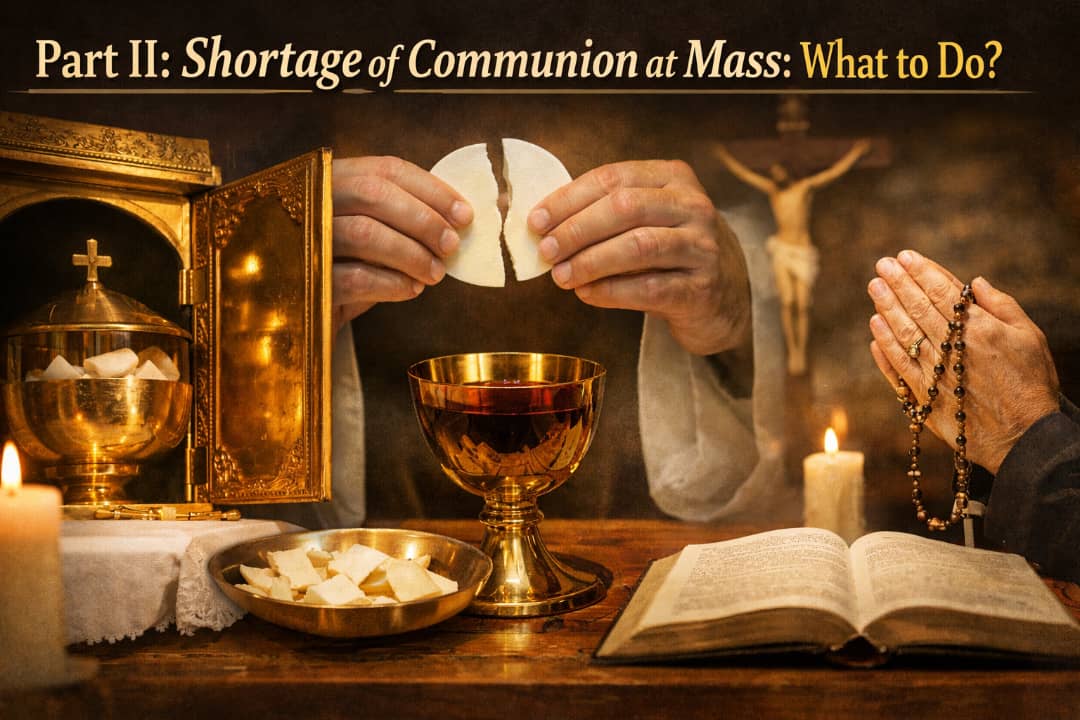
Although the Catechism of the Catholic Church (1389) acknowledges situations in which sacramental reception is not possible, the proper course of action when consecrated hosts run short after the consecration is to use reserved consecrated hosts from the tabernacle, in accordance with liturgical norms. While ‘the sign of communion is more complete when given under both kinds, since in that form the sign of the Eucharistic meal appears more clearly’ (CCC, 1390; GIRM, 281), it remains permissible to distribute Holy Communion under one species alone. Indeed, if consecrated hosts are insufficient, Communion may be given under the species of wine only, since ‘the Catholic faith teaches that Christ, whole and entire, and the true Sacrament, is received even under only one species, and consequently that as far as the effects are concerned, those who receive under only one species are not deprived of any of the grace that is necessary for salvation’ (GIRM 282, 285-286; cf. Council of Trent, session 21, chapters 1-3: Denz-Schön, 1725-1729; CCC 1390).
Proactively, the consecrated hosts that are available may also be broken into smaller pieces and shared among the faithful. ‘Small hosts are, in no way ruled out when the number of those receiving Holy Communion or other pastoral needs require it. The action of the fraction or breaking of bread, which gave its name to the Eucharist in apostolic times, will bring out more clearly the force and importance of the sign of unity of all in the one bread, and of the sign of charity by the fact that the one bread is distributed among the brothers and sisters’ (GIRM 321). As the Church teaches, ‘Christ is present whole and entire in each of the species and whole and entire in each of their parts, in such a way that the breaking of the bread does not divide Christ’ (CCC 1377; cf. Mysterium Fidei, 46). Accordingly, the Council of Trent (Session XIII, Canon III) solemnly defined: ‘If anyone denies that in the venerable sacrament of the Eucharist the whole Christ is contained under each species and under each part of either species when separated, let him be anathema.’
Even in circumstances where sacramental communion is not possible, participation at Mass remains necessary, important, meaningful and fruitful. In such circumstances it is beneficial to cultivate a desire for full union with Christ through the practice of spiritual communion (BXVI, Sacramentum Caritatis, 55). The Council of Trent (Session XIII, cf. VIII) long ago recognized the legitimacy of this mode of reception, teaching that the Eucharist may be received ‘sacramentally only, spiritually only, and both sacramentally and spiritually… Those who receive it (Eucharist) spiritually only are those who, ardently desiring the heavenly bread, partake of its fruit and benefit.’
In 2003, Pope John Paul II in Ecclesia de Eucharistia (34) reaffirmed this tradition, teaching that a constant desire for the Eucharist is “the origin of the practice of ‘spiritual communion’, which has happily been established in the Church for centuries and recommended by saints who were masters of the spiritual life. Saint Teresa of Jesus (Camino de Perfección, Chapter 35) wrote: ‘When you do not receive communion and you do not attend Mass, you can make a spiritual communion, which is a most beneficial practice; by it the love of God will be greatly impressed on you.’” Earlier witnesses of this tradition include the Angelic Doctor (Summa Theologiae, III, q. LXXX, a. 1, 2) and St. Alphonsus Liguori who taught that ‘if the consecrated hosts are not sufficient, the priest may not consecrate others, but some must go without Communion’ (Theologia Moralis, bk. VI).
In humble and prudent sincerity therefore, those who for no fault of theirs had their right (cf. CIC Can. 843) to feed on the Lord’s flesh unintentionally impeded, may be rightly guided toward spiritual communion, through which genuine union with Christ is fostered.
Conclusion
“Whenever an abuse is committed in the celebration of the sacred Liturgy, it is to be seen as a real falsification of Catholic Liturgy. St Thomas wrote, ‘the vice of falsehood is perpetrated by anyone who offers worship to God on behalf of the Church in a manner contrary to that which is established by the Church with divine authority, and to which the Church is accustomed’. In order that a remedy may be applied to such abuses, ‘there is a pressing need for the biblical and liturgical formation of the people of God, both pastors and faithful’, so that the Church’s faith and discipline concerning the sacred Liturgy may be accurately presented and understood. Where abuses persist, however, proceedings should be undertaken for safeguarding the spiritual patrimony and rights of the Church in accordance with the law, employing all legitimate means” (RS, 169-170).
When confronted with liturgical challenges such as a shortage of sacred species at Mass, fidelity to the Church and sound catechesis is essential, not abuse. In such situations, ministers ‘are to teach, furthermore, that the Church, in her stewardship of the Sacraments, has the power to set forth or alter whatever provisions, apart from the substance of the Sacraments, that she judges to be most conducive to the veneration of the Sacraments and the well-being of the recipients, in view of changing conditions, times, and places’ (GIRM 282; cf. Council of Trent, session 21, chapter 2: Denz-Schön, 1725-1728.).
finally, “in keeping with the solemn promises that they have made in the rite of Sacred Ordination and renewed each year in the Mass of the Chrism, let Priests celebrate ‘devoutly and faithfully the mysteries of Christ for the praise of God and the sanctification of the Christian people, according to the tradition of the Church, especially in the Eucharistic Sacrifice and in the Sacrament of Reconciliation.’ They ought not to detract from the profound meaning of their own ministry by corrupting the liturgical celebration either through alteration or omission, or through arbitrary additions. For as St. Ambrose said, ‘It is not in herself . . . but in us that the Church is injured. Let us take care so that our own failure may not cause injury to the Church.’ Let the Church of God not be injured, then, by Priests who have so solemnly dedicated themselves to the ministry. Indeed, under the Bishop’s authority let them faithfully seek to prevent others as well from committing this type of distortion” (RS, 31).




Leave a Reply